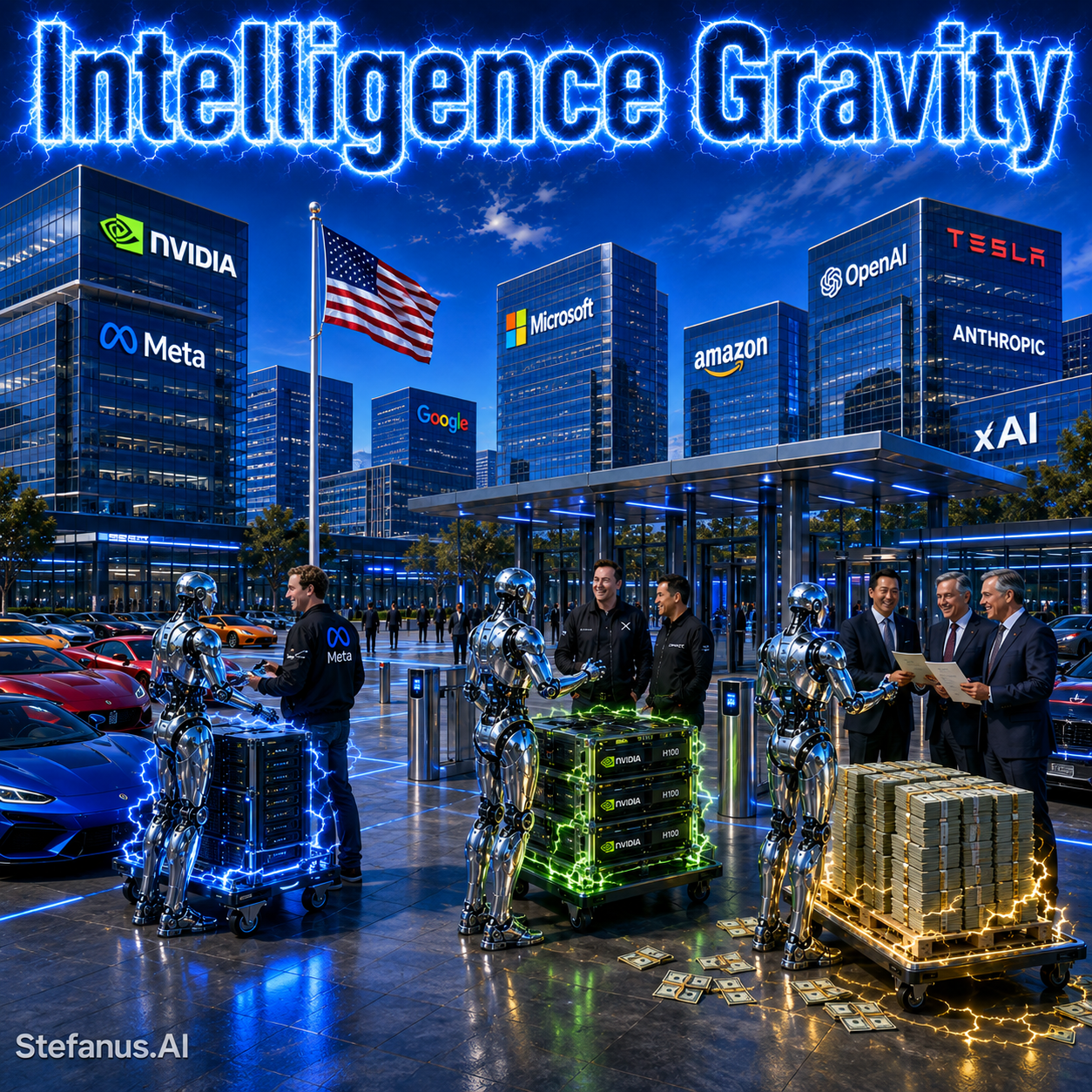

Introduction: The Force That Organizes Everything
For centuries, gravity has been one of the most fundamental forces in nature. It pulls stars into galaxies, binds planets to the Sun, and shapes the architecture of the physical universe. Gravity is invisible, yet its influence is unmistakable and everywhere. It determines where matter accumulates, how systems organize themselves, and why certain celestial bodies become centers around which everything else must revolve. A cloud of interstellar dust does not decide to become a star; it becomes one because, past a certain threshold of accumulated mass, the physics of attraction leaves it no other destiny. Without gravity there would be no galaxies, no solar systems, and no stable planetary civilizations—only a thin, undifferentiated fog of matter drifting through darkness, everywhere present and nowhere consequential.
Artificial intelligence appears to be creating an economic equivalent of this universal force. There is, of course, no physical law compelling entrepreneurs to relocate to the San Francisco Bay Area, no equation of motion that forces semiconductor manufacturers to sink more than a quarter of a trillion dollars into the desert north of Phoenix, no gravitational constant that draws hyperscale campuses to the plains of West Texas or the farmland of northern Indiana. And yet these decisions, made independently by thousands of executives, investors, engineers, governors, and heads of state, increasingly follow a recognizable and remarkably consistent pattern. Capital flows toward existing capital. Talent migrates toward existing talent. Universities deepen their collaborations with established innovation hubs rather than seeding new ones. Energy infrastructure expands where compute demand is already strongest, and compute demand grows where energy infrastructure already exists. Like celestial objects responding to gravitational attraction, each participant in the AI economy is responding to invisible forces that continuously reinforce one another, and the aggregate result is a landscape that looks less like the flat, frictionless digital world once promised by the internet era and more like a night sky: vast stretches of near-emptiness punctuated by a small number of brilliant, massive, and ever-growing centers of light.
The scale of this accumulation, as of the summer of 2026, has moved beyond anything in the history of private capital formation. Amazon, Microsoft, Alphabet, and Meta have collectively guided toward approximately $725 billion in capital expenditures for calendar year 2026—up roughly 77 percent from the already record-breaking $410 billion deployed in 2025—with Goldman Sachs now projecting more than $5 trillion in combined spending from these four companies alone between 2025 and 2030 [1]. When Oracle is included, aggregate hyperscaler capital expenditure for fiscal 2026 is expected to exceed $690 billion, and calendar-year guidance, once finance leases and customer pre-payments are counted, points toward nearly $800 billion [7]. Nvidia, the company whose processors sit at the center of this build-out, reported revenue of $96.2 billion for its fiscal second quarter ended July 26, 2026—up 106 percent from a year earlier, with data center revenue of $89.0 billion up 117 percent—and guided the following quarter to approximately $108 billion [2]. Its founder and chief executive framed the moment in language that could serve as the epigraph for this entire paper:
“AI has reached its inflection point. It’s doing useful work.”
— Jensen Huang, Founder and CEO, NVIDIA [2]
This paper introduces the concept of Intelligence Gravity, a framework describing how artificial intelligence generates self-reinforcing centers of attraction that reshape geography, economics, industrial policy, and geopolitical competition. Intelligence Gravity extends far beyond algorithms or GPUs. It encompasses the cumulative pull created by abundant electricity, advanced semiconductor manufacturing, world-class universities, deep venture capital, frontier laboratories, favorable regulation, sovereign investment, robotics ecosystems, and digital infrastructure. Once these assets begin concentrating within a region, they become progressively harder—and eventually, this paper will argue, effectively impossible—for competitors to replicate from a standing start, because every additional unit of mass increases the field strength that attracts the next unit of mass.
Unlike previous industrial revolutions, in which natural resources or transportation networks largely determined economic leadership, the AI era rewards ecosystems capable of concentrating multiple forms of strategic capital simultaneously. Nvidia, OpenAI, Anthropic, Google, Meta, Amazon, Microsoft, xAI, SpaceX, TSMC, electric utilities, state governors, research universities, sovereign wealth funds, and federal policymakers are not acting independently; whether they intend to or not, they have become participants in a single, larger gravitational system whose dynamics none of them fully controls. As AI investment accelerates into the high hundreds of billions of dollars annually—with analysts now projecting combined hyperscaler spending to surpass $1 trillion in 2027 [9]—intelligence itself is becoming the organizing force of the twenty-first-century economy: attracting industries, reshaping states, redrawing the map of energy demand, influencing national security doctrine, and redefining what it means for a nation to be globally competitive.
Why “Intelligence Gravity”?
The title Intelligence Gravity was deliberately chosen because it captures a phenomenon that conventional economic terminology cannot fully explain, even though several established literatures illuminate portions of it. Alfred Marshall’s industrial districts, Michael Porter’s competitive clusters, the endogenous growth theory of Paul Romer, the network-effects economics that explained the platform era, and the modern agglomeration research associated with economists such as Enrico Moretti and Edward Glaeser all describe fragments of the process. Economies of scale explain why a single data center campus grows larger; network effects explain why a single software platform becomes dominant; agglomeration economics explains why skilled workers earn more when they work near other skilled workers. But none of these frameworks, taken individually, adequately explains why entire AI ecosystems appear to accelerate—not merely persist, but accelerate—once they cross a critical threshold of accumulated capability. Intelligence Gravity proposes that AI ecosystems develop their own momentum, continuously attracting additional resources simply because they have already become centers of intelligence production, in precisely the way that a massive body warps the space around it so that other bodies fall toward it without any force being consciously applied.
The distinction matters because gravity, unlike a network effect, operates on everything at once. A network effect binds users of a common platform; gravity binds heterogeneous objects—capital and electrons, students and substations, sovereign wealth funds and construction crews—that share nothing except proximity to the same center of mass. When Stanford’s Digital Economy Lab publishes research, when a Series A fund on Sand Hill Road raises a new vehicle, when Dominion Energy plans a new 500-kilovolt transmission line, when the Public Investment Fund of Saudi Arabia allocates tens of billions of dollars to a national AI champion, and when a twenty-four-year-old machine learning researcher in Bangalore decides where to build her career, these actors are not participating in any shared network in the conventional sense. They are responding, each in their own currency, to the same gravitational field. This is why the classical vocabulary falls short and why a new term is warranted.
The term also deliberately broadens the discussion beyond computing infrastructure. The future winners of artificial intelligence will not merely possess faster GPUs or larger language models, because chips depreciate and model leadership, as the Stanford AI Index has documented, now changes hands in months rather than years, with the top-ranked frontier model in March 2026 holding a lead of only 2.7 percent over its nearest competitor [3]. What endures is not any single artifact but the field itself: the ability to attract entrepreneurs, scientists, engineers, investment capital, semiconductor fabrication, electrical generation, transmission infrastructure, robotics manufacturing, governmental support, research institutions, and international partnerships, and to convert each new arrival into additional attractive force. Understanding Intelligence Gravity therefore provides a framework not only for technology companies but also for governors, federal agencies, institutional investors, infrastructure developers, utilities, universities, and geopolitical strategists seeking to understand why AI leadership increasingly concentrates within a relatively small number of strategic ecosystems—and what, if anything, can still be done by those outside them.

Section 1: Foundations of Intelligence Gravity
1.1 Defining Intelligence Gravity
Intelligence Gravity can be defined as the self-reinforcing attractive force exerted by concentrations of AI-relevant assets—compute, capital, talent, energy, and policy—such that each incremental addition to the concentration increases the probability, speed, and scale of subsequent additions. The definition contains three load-bearing ideas that deserve careful elaboration, because each one distinguishes this framework from the looser language of “hubs” and “clusters” that has dominated regional economic development discourse for decades.
The first idea is self-reinforcement. In an ordinary industrial cluster, the benefits of co-location—shared suppliers, thick labor markets, knowledge spillovers—are real but bounded, and they eventually diminish as congestion costs rise: land grows expensive, wages inflate, and traffic thickens until the marginal firm is indifferent between locating inside the cluster and outside it. Intelligence Gravity behaves differently because the core asset being accumulated is intelligence itself, which does not congest in the same way physical industries do. A frontier model trained in one campus improves the productivity of every researcher, every startup, and every enterprise connected to the ecosystem that produced it; the better the models, the more valuable it becomes to be near the institutions that build them; and the more valuable proximity becomes, the more resources flow inward, financing the next and better generation of models. The loop closes on itself and tightens with each revolution.
The second idea is multi-asset simultaneity. A region can possess world-class universities without venture capital, as much of Europe demonstrates, or abundant cheap energy without research talent, as many resource economies demonstrate, and in either case the gravitational field remains weak. It is the simultaneous presence of the five asset classes—developed at length in subsection 1.4 below—that produces the compounding attraction this paper describes. This simultaneity requirement is also why so few genuine centers of Intelligence Gravity exist in the world today, and why the list of plausible new entrants is short and shrinking.
The third idea is probabilistic rather than deterministic causation. Gravity does not command any particular object to fall; it changes the odds and the trajectories for all objects at once. Intelligence Gravity likewise does not guarantee that any specific startup will locate in the Bay Area, that any specific fabrication plant will be built in Arizona, or that any specific sovereign fund will invest in an American frontier laboratory. It ensures instead that, across thousands of independent decisions, the aggregate flow bends measurably and persistently toward the existing centers of mass—which is exactly the pattern the data of 2020 through 2026 reveals.
1.2 Gravity versus Traditional Network Effects
It is worth dwelling on the difference between Intelligence Gravity and the network-effects framework that dominated economic analysis of the platform era, because the two are easily conflated and the conflation obscures what is genuinely new. A network effect describes rising value from rising participation within a single system: each additional telephone made every existing telephone more useful, each additional social media user made the platform more engaging, each additional marketplace seller attracted additional buyers. Network effects are powerful, but they are also confined to the boundary of the network. Facebook’s network effect did not make the electric grid around Menlo Park more valuable; Visa’s network effect did not attract physicists to any particular city.
Intelligence Gravity crosses these boundaries routinely, and that boundary-crossing is its defining behavior. When Anthropic’s revenue run-rate expands, the effect propagates outward through entities that share no platform with Anthropic at all: memory manufacturers accelerate capacity expansion, utilities revise decade-long load forecasts, landlords in San Francisco reprice office space, Amazon commits additional tens of billions of dollars in capital [48], and the government of South Korea structures semiconductor partnerships partly around the demand of American frontier laboratories [32]. When TSMC expands in Phoenix, community colleges redesign curricula, water authorities build reclamation plants, and dozens of chemical and equipment suppliers relocate to Arizona [14]. The gravitational field converts investment in any one layer of the AI economy into attractive force across every other layer. Network effects deepen a single well; Intelligence Gravity curves the entire surrounding landscape so that everything rolls in the same direction.
1.3 Why AI Creates Self-Reinforcing Ecosystems
The deeper question is why artificial intelligence, more than previous general-purpose technologies, generates this compounding dynamic. Four structural properties of the technology provide the answer. First, AI exhibits extreme returns to scale in its production function: the empirical scaling relationships that have governed frontier model development since 2020 reward those who can assemble the largest coherent quantities of compute, data, and researchers, which means the largest existing concentrations enjoy a persistent advantage in producing the next generation of capability. Second, AI capability is unusually general in its application, which means the demand pulling on any center of intelligence production comes from every sector of the economy simultaneously rather than from a single industry that might mature or decline. Third, the physical requirements of frontier AI—gigawatt-scale electricity, advanced-node semiconductors, exotic cooling, ultra-low-latency networking—are themselves subject to enormous economies of scale and multi-year lead times, so the regions that began building early hold advantages measured not in cost percentages but in years of calendar time that no amount of money can compress. Fourth, and most subtly, AI production is intensely knowledge-tacit: the practical craft of training frontier models resides in a few thousand individuals worldwide, and tacit knowledge diffuses primarily through physical proximity, employer-hopping within a region, and the informal social networks that dense ecosystems uniquely provide. Erik Brynjolfsson and Gabriel Unger, writing for the International Monetary Fund, anticipated the stakes of these dynamics when they argued that the collective decisions made in this decade will determine how AI shapes productivity growth, income inequality, and industrial concentration for a generation [4].
Each of these four properties would, on its own, encourage some degree of clustering. Operating together, they transform clustering from a tendency into something closer to a law of motion, which is precisely the phenomenon the gravitational metaphor is meant to capture.
1.4 The Five Sources of Gravitational Attraction
Every gravitational field in the AI economy draws its strength from five distinguishable but interlocking sources, and the analytical usefulness of the framework comes largely from examining how the five interact.
Compute is the first and most visible source. The possession of large, modern, coherently networked accelerator fleets—whether Nvidia’s Blackwell and Rubin generations, Google’s TPUs, or Amazon’s Trainium—constitutes the raw mass at the center of every AI ecosystem, and access to that mass is now the binding constraint on frontier laboratories, as demonstrated most vividly by Anthropic’s reported willingness to commit roughly $15 billion per year for exclusive access to the more than 220,000 GPUs of the Colossus 1 facility in Memphis [47]. Capital is the second source: the venture funds, sovereign wealth vehicles, infrastructure funds, private credit desks, and hyperscaler balance sheets whose combined willingness to finance the build-out reached historic proportions by mid-2026, when incremental annual debt across the five largest hyperscalers had risen from 9 percent of capital expenditure in fiscal 2024 to 32 percent on a trailing basis [7]. Talent is the third: the researchers, infrastructure engineers, and applied scientists whose scarcity is so severe that compensation packages at frontier laboratories have reached levels previously reserved for professional athletes, and whose geographic choices are the single most reliable predictor of where the next generation of AI companies will be founded. Energy is the fourth and, as Section 3 will argue, increasingly the decisive source: gigawatt-class electricity delivered with utility-grade reliability has become the scarcest input in the entire stack, the one that cannot be fabricated in a cleanroom or wired from a bank account. Policy is the fifth: the permitting regimes, tax structures, export-control frameworks, land-use decisions, and national strategies through which governments either amplify or dampen the gravitational field within their borders.
| Source of Attraction | What It Consists Of | Illustrative 2025–2026 Evidence |
| Compute | Accelerator fleets, AI factories, custom silicon | Nvidia data center revenue of $89.0B in a single quarter [2]; AWS agreement to deploy 2 million Nvidia GPUs [9] |
| Capital | VC, sovereign funds, hyperscaler capex, private credit | ~$725B combined 2026 capex guidance from four hyperscalers [1]; U.S. private AI investment of $285.9B in 2025 [3] |
| Talent | Researchers, ML engineers, infrastructure builders | 1,953 newly funded U.S. AI companies in 2025, more than 10x any other country [3] |
| Energy | Generation, transmission, cooling, fuel supply | More than 9.8 GW of nuclear capacity contracted by hyperscalers across 13 deals [22] |
| Policy | Permitting, incentives, export controls, national strategy | America’s AI Action Plan and data-center permitting executive orders of July 2025 [40][41] |
The essential insight of the table is not contained in any single row but in the interaction among rows: compute cannot operate without energy, energy investment is unlocked by capital, capital follows talent, talent follows the research frontier that compute makes possible, and policy can accelerate or retard every one of these couplings. A region strong in four sources and absent in one will find its gravitational field leaking strength through the missing dimension, which is why, for example, energy-rich regions without talent pipelines have historically captured data centers but not laboratories, and talent-rich regions without energy are now watching their compute migrate elsewhere.
1.5 From Industrial Clusters to Intelligence Clusters
The final foundation is historical perspective. Industrial clusters have always existed: Manchester’s cotton mills, Pittsburgh’s steel, Detroit’s automobiles, Hollywood’s film industry, and Silicon Valley’s semiconductors each demonstrated that co-location breeds capability. But the intelligence clusters forming in the 2020s differ from their industrial ancestors in three respects that justify treating them as a new species rather than a larger instance of the old one. Their input intensity is inverted: where industrial clusters were organized around access to material inputs and shipping lanes, intelligence clusters are organized around access to electrons and photons—electricity and bandwidth—plus a labor force numbering in the mere thousands whose output nonetheless propagates globally at zero marginal cost. Their capital velocity is unprecedented: Detroit took half a century to assemble the capital stock that made it the arsenal of democracy, while Abilene, Texas went from groundbreaking to operating one of the largest computing facilities on Earth in under two years [12], and Amazon’s Project Rainier campus in Indiana went, in the words of AWS chief executive Matt Garman, from farmland to frontier infrastructure in barely twelve months:
“Cornfields to data centers, almost overnight.”
— Matt Garman, CEO, Amazon Web Services [25]
And their output universality is without precedent: steel from Pittsburgh had to be shipped and priced, but intelligence produced in an AI cluster is delivered planet-wide, instantly, into every industry at once, which means the economic gravity of an intelligence cluster is felt everywhere even as its benefits concentrate locally—a asymmetry with profound distributional and political consequences that Sections 5 and 6 will examine.
1.6 Measuring the Field: Indicators of Gravitational Strength
If Intelligence Gravity is to be more than an evocative image, it must be measurable, and the evidence assembled for this paper suggests five families of indicators through which the strength of any region’s field can be tracked over time. The first is capital flux: the volume of AI-directed investment entering a region per year, for which the cleanest available series are the hyperscaler capital expenditure disclosures—now approaching $800 billion annually across the five largest operators [50]—and the private investment tallies compiled by the Stanford AI Index, which recorded $285.9 billion flowing into American AI companies in 2025 against $12.4 billion of tracked private investment in China [3]. The second is energy commitment: contracted firm generation dedicated to compute, visible in power purchase agreements, interconnection filings, and the nearly ten gigawatts of nuclear capacity the hyperscalers have now reserved [22]. The third is talent flow, the most leading of all the indicators because people move before buildings rise, and the one currently flashing the most interesting signal for the United States—an 89 percent decline since 2017 in AI researchers and developers migrating into the country [3]. The fourth is institutional density: the count of frontier laboratories, anchor universities, and specialized suppliers within commuting distance of one another, which no single statistic captures but which the founding rate of new AI companies proxies well [3]. The fifth is policy velocity: the elapsed time between a project’s announcement and its energization, which compresses where governments have organized themselves around the build-out—Texas’s queue reforms [21] and the federal permitting orders of 2025 [41] being the clearest American examples—and stretches where they have not. A region that improves on all five indicators simultaneously is gaining mass; a region improving on some while deteriorating on others is changing the composition of its field; and a region deteriorating on all five is not standing still but falling outward, because in a gravitational system there is no such thing as a stationary position, only orbits maintained or decayed.

Section 2: The Physics of the AI Economy
If Section 1 defined the gravitational field, Section 2 examines its mechanics—the specific behavioral loops through which founders, capital, chips, universities, and governments each respond to and simultaneously strengthen the attraction of existing centers. The purpose of walking through these five actor classes one at a time is to demonstrate that Intelligence Gravity is not a single mechanism but a superposition of many mechanisms, each individually explicable, whose combined effect is far greater than any of them alone.
2.1 Why Founders Keep Clustering
The entrepreneurial case for clustering has been understood since the earliest studies of Silicon Valley, but the AI era has intensified every element of it. A founder building a frontier-adjacent company in 2026 needs four things within arm’s reach: capital that understands the technology well enough to underwrite it, talent fluent in a rapidly evolving research literature, customers sophisticated enough to adopt early, and—new to this era—access to compute allocations that are frequently brokered through personal relationships rather than posted prices. All four are overwhelmingly concentrated in a handful of ecosystems, and the concentration is measurable: of the 1,953 newly funded AI companies the United States produced in 2025—itself more than ten times the count of any other country—a decisive majority formed in the Bay Area’s orbit [3]. The mechanism is cumulative in a way that mirrors stellar formation. Each generation of successful companies mints a cohort of operators who have watched scaling happen from the inside; those operators become the serial founders and angel investors of the next generation; their departures from incumbent laboratories seed new companies that raise capital from investors located blocks away; and the density of the resulting social graph lowers the friction of every subsequent founding. A founder in a thin ecosystem must build her own gravity; a founder in a thick one simply falls along the field lines that ten thousand prior careers have already carved into the landscape. The rational response, repeated across thousands of individual decisions, is to relocate toward the existing mass—which is why the AI startup flywheel spins where it already spins, and why attempts to decree new startup capitals by subsidy alone have so consistently underperformed the organic centers.
2.2 Why Capital Keeps Clustering
Capital exhibits the same centripetal behavior, but for reasons rooted in the economics of information and risk rather than social proximity. The amounts now required to participate meaningfully in the AI build-out have escalated beyond the underwriting capacity of dispersed, generalist capital: single financing events for individual laboratories now reach into the tens of billions of dollars, single data center campuses absorb more capital than entire national infrastructure programs of previous decades, and the aggregate five-hyperscaler build-out for fiscal 2026—expected to exceed $690 billion in cash capital expenditure, roughly triple the level of 2024 [50]—has drawn sovereign wealth funds, private equity, infrastructure funds, and the private credit industry into structures of remarkable complexity. What makes this capital cluster rather than disperse is that underwriting AI infrastructure requires proprietary knowledge that is itself gravitationally concentrated: an infrastructure fund cannot price a fifteen-year lease on a gigawatt campus without understanding accelerator depreciation curves, model economics, and interconnection queues, and the analysts who understand those things sit in the same handful of cities as the companies they analyze. The consequences of this concentration became newly visible in 2026 as the build-out outran even the largest balance sheets in corporate history. Free cash flow across the hyperscalers compressed sharply—Amazon’s trailing free cash flow fell by roughly 95 percent as its approximately $200 billion capital program consumed operating cash [49]—and the companies turned decisively toward external financing, with incremental annual debt across the group rising from 9 percent of capex in fiscal 2024 to 32 percent by mid-2026 [7]. Longbow Asset Management’s chief executive captured the investor arithmetic bluntly:
“It’s going to reduce your free cash flow.”
— Jake Dollarhide, CEO, Longbow Asset Management [6]
Markets have begun to enforce discipline on this spending—Alphabet’s July 2026 decision to raise its capital expenditure ceiling to as much as $205 billion triggered a 7 percent single-day decline and dragged its peers down with it [8], and Moody’s warned in May 2026 of credit consequences should AI profits fail to materialize [49]—but the essential point for the gravitational framework is that even this skepticism concentrates: the scrutiny, the financing structures, the ratings debates, and the eventual resolution all occur within and around the same centers of mass, deepening rather than diluting their informational advantage.
2.3 Why GPUs Keep Clustering
The clustering of compute is governed by physics more directly than any other layer, and it therefore provides the cleanest illustration of the gravitational logic. Modern training clusters derive their value from coherence—the ability of tens or hundreds of thousands of accelerators to behave as a single machine—and coherence degrades with distance, because the speed of light imposes latency penalties on every meter of separation between racks. This creates an overwhelming incentive to build dense, contiguous, gigantic campuses rather than distributed networks of modest facilities. Dense campuses, in turn, demand what only a small number of locations on Earth can provide: hundreds of megawatts to multiple gigawatts of firm power, water or advanced liquid-cooling capacity, fiber routes to the internet’s backbone, land measured in the hundreds of acres, and a construction labor force in the thousands. Once a location has demonstrated that it can deliver these prerequisites, the proof itself becomes an asset—substations exist, supply chains are primed, permitting precedents are established, and the utility’s engineers have already modeled the load—so the next campus lands beside the last one. This is how Abilene, Texas became the flagship of the Stargate program, with a campus designed for roughly 1.2 gigawatts across eight buildings under a fifteen-year Oracle lease [12]; it is how the surrounding counties of West Texas came to host more data center capacity under construction than the entire Europe, Middle East, and Africa region combined [20]; and it is how Memphis, Tennessee—chosen by xAI for the speed with which an abandoned appliance factory could be energized—became home to Colossus, whose second installation came online in January 2026 as a gigawatt-scale training cluster while its first, with more than 220,000 GPUs and roughly 300 megawatts of draw, was leased in its entirety to a rival laboratory [46][47]. Even the failures reinforce the pattern: when OpenAI and Oracle stepped back from a 600-megawatt Abilene expansion in early 2026 because grid interconnection would have taken more than a year, the constraint that stopped them was precisely the gravitational scarcity—firm power—that makes existing energized sites so valuable, and Nvidia reportedly moved within weeks to secure the vacated capacity for other tenants [13].
2.4 Why Universities Become Gravitational Anchors
Universities occupy a distinctive position in the gravitational system because they are simultaneously sources of mass and beneficiaries of the field. A great research university generates the two inputs that cannot be purchased on any spot market: new fundamental knowledge and a continuous stream of trained talent. In return, proximity to an active AI ecosystem transforms the university itself—its faculty gain access to compute and problems at industrial scale, its graduates gain employment gradients unavailable elsewhere, its licensing offices gain commercialization channels, and its fundraising gains an entire generation of newly wealthy alumni. Stanford’s relationship to the Bay Area remains the canonical case, with its Human-Centered AI Institute now producing the AI Index that the entire world, this paper included, treats as the authoritative measurement of the field [3], and its Digital Economy Lab, under Erik Brynjolfsson, producing the empirical research on AI’s labor market and productivity effects that policymakers cite on every continent [34]. Carnegie Mellon has played the anchoring role for Pittsburgh’s robotics and AI corridor so effectively that when Pennsylvania staged its landmark energy and innovation summit in July 2025, the venue chosen was the university itself [27]. MIT anchors the Boston ecosystem and, through figures such as Nobel laureate Daron Acemoglu, supplies the AI economy with its most rigorous internal critic [36]. The University of Texas system, Texas A&M, and Arizona State University have become explicit instruments of state industrial strategy, redesigning engineering curricula around semiconductor fabrication and grid engineering as their states absorb historic manufacturing investment. The gravitational point is that these institutions cannot be quickly replicated: a university’s reputation, faculty network, and alumni graph compound over decades, which means regions that lack an anchor institution face a bootstrapping problem measured in generations, not budget cycles.
2.5 Why Governments Amplify Gravity
Governments are the fifth mass in the system, and their distinctive property is leverage: a policy decision costing little to enact can multiply or suppress billions of dollars of private gravitational flow. The American federal posture shifted decisively in July 2025, when the White House released “Winning the Race: America’s AI Action Plan,” a three-pillar strategy explicitly organized around accelerating innovation, building AI infrastructure, and extending American AI leadership abroad, accompanied by executive orders directing federal agencies to expedite permitting for data centers and their supporting transmission, generation, and grid equipment [40][41]. Stanford’s Institute for Human-Centered AI characterized the plan as a decisive turn toward market-driven growth and light-touch governance framed around the imperative to win the AI race [40]. At the state level, governors have become open competitors for gravitational mass: Texas pairs a deregulated energy market with aggressive interconnection reform as its grid operator forecasts statewide demand of roughly 175,000 megawatts within six years, more than double today’s peak [19]; Arizona converted a single 2020 recruitment of TSMC into what is now the largest foreign direct investment in American history [15]; Pennsylvania’s July 2025 summit catalyzed more than $90 billion in announced commitments across data centers, generation, and workforce programs [27], nineteen of twenty of which were reported on track a year later [28]. Internationally, as Section 4.6 will develop, entire national strategies—Emirati, Saudi, Japanese, Korean, Indian—are now built on the premise that governments can seed gravitational fields with sovereign capital and diplomatic alignment. The historical record suggests governments cannot create Intelligence Gravity from nothing, but the record of 2024 through 2026 demonstrates conclusively that they can amplify existing fields, bid for orbiting mass, and—through export controls and permitting—reshape the trajectories along which everything else falls.

Section 3: Intelligence Gravity Across the Five-Layer AI Economy
The AI economy is best understood as a vertical stack of five layers, each with its own capital intensity, time constants, and geography, and each exerting gravitational pull on the layers above and below it. Reading the stack from bottom to top—energy, silicon, infrastructure, models, agents—reveals a structural inversion that is among the most important findings of this paper: the further down the stack one descends, the slower, heavier, and more geographically binding the assets become, which means the bottom layers increasingly determine where the top layers can exist at all.
| Layer | Core Assets | Time Constant | Representative Actors and Evidence |
| Layer 1: Energy | Generation, transmission, fuel, cooling | 5–15 years | 13 hyperscaler nuclear deals totaling 9.8+ GW [22]; ERCOT forecasting ~175 GW Texas demand within six years [19] |
| Layer 2: Silicon | Fabs, advanced packaging, memory, lithography | 3–7 years | TSMC’s $265B Arizona program, the largest FDI in U.S. history [14][15] |
| Layer 3: Infrastructure | Hyperscale campuses, AI factories, fiber, substations | 1–4 years | ~$725B combined 2026 capex from four hyperscalers [1]; Stargate’s seven U.S. sites [11] |
| Layer 4: Models | Frontier laboratories, training runs, research talent | Months–2 years | Frontier leadership margin of 2.7% as of March 2026 [3]; Nvidia Q2 FY27 data center revenue of $89.0B [2] |
| Layer 5: Agents | Enterprise AI, robotics, autonomous systems, applications | Weeks–quarters | 88% organizational AI adoption; ~53% population adoption of generative AI within three years [3] |
3.1 Layer One — Energy Gravity
Energy is the foundation of the stack and, by 2026, its most binding constraint, a reversal that would have seemed implausible to the software-centric technology industry of a decade ago. The numbers explain the reversal. A single flagship campus such as Stargate Abilene is designed for approximately 1.2 gigawatts [12]; Amazon’s Rainier campus in Indiana will ultimately draw about 2.2 gigawatts, enough to power more than 1.6 million homes [25]; xAI’s Colossus 2 alone draws on the order of a gigawatt, exceeding the peak demand of the city of San Francisco [46]; and the Electric Reliability Council of Texas has watched its large-load interconnection queue swell to roughly 226 gigawatts of requests—2.6 times the state’s all-time peak demand—of which the overwhelming majority is data centers [20][21]. Against this demand, the hyperscalers have executed the most consequential corporate energy procurement campaign in history, contracting more than 9.8 gigawatts of nuclear capacity across at least thirteen deals: Microsoft’s twenty-year power purchase agreement to restart Three Mile Island Unit 1, now the Crane Clean Energy Center, with power expected in 2027; Amazon’s 1.9-gigawatt arrangement with Talen Energy’s Susquehanna plant and its $700 million investment in X-energy’s small modular reactors; Google’s pioneering fleet agreement with Kairos Power for 500 megawatts of advanced reactors; and Meta’s commitments of up to 6.6 gigawatts spanning TerraPower, Oklo, Vistra, and Constellation [22][24]. Alongside nuclear, on-site natural gas has become the bridge fuel of the build-out—at least three of Stargate’s seven American sites will rely on it to bypass interconnection queues entirely [11], while Pennsylvania’s Homer City redevelopment is constructing the largest natural gas plant in the nation, backed by a $15 billion fuel agreement, expressly to feed an AI campus [27][28]. Google’s own AI infrastructure lead distilled the entire layer into a single sentence:
“An engine without fuel is almost useless.”
— Manuel Greisinger, AI Infrastructure Lead, Google [23]
The gravitational implication is profound: because generation and transmission assets take five to fifteen years to build, the map of mid-2030s AI capacity is being drawn now, in the interconnection queues and permitting dockets of the mid-2020s, and regions that hesitate are not merely delaying their participation—they are forfeiting it.
3.2 Layer Two — Silicon Gravity
One layer up sits the silicon economy, whose gravitational structure is the most concentrated of the five because its supply chain narrows, at its most advanced nodes, to a handful of firms and a handful of buildings. Nvidia’s position at the center of this layer produced, in fiscal 2026, full-year revenue of $215.9 billion, up 65 percent [10], followed by the $96.2 billion quarter of August 2026 in which data center revenue alone reached $89.0 billion and guidance pointed to $108 billion for the quarter ahead [2]—figures that make a single chip designer’s quarterly results a macroeconomic event tracked by central banks. Beneath Nvidia, the fabrication chokepoint remains Taiwan Semiconductor Manufacturing Company, and it is here that silicon gravity has produced its most spectacular geographic consequence: TSMC’s Arizona program, begun as a $12 billion single-fab commitment in 2020, expanded to $65 billion, then $165 billion, and—following a July 2026 announcement of an additional $100 billion—now stands at $265 billion across a planned complex of six or more logic fabs, two advanced packaging facilities, and a research center, the largest foreign direct investment in a greenfield project in American history [14][15]. Upon completion of the announced facilities, roughly 30 percent of TSMC’s capacity at 2 nanometers and below will be located in Arizona, creating for the first time an independent leading-edge manufacturing cluster on American soil [15], within a state that has attracted more than $314 billion of semiconductor investment across some seventy expansions since 2020 [15]. Memory has become the layer’s newest pressure point: Nvidia warned investors in August 2026 that its gross margins would trough in early fiscal 2027 partly because of memory prices, with its chief financial officer acknowledging that the scarcity was being driven in large part by the AI build-out itself [9]—a perfect miniature of gravitational feedback, in which the expansion of one layer bids up the inputs of its own foundation. The silicon layer is also where geopolitics intrudes most directly, through the export-control regime examined in Section 5.3, because a supply chain this concentrated is a supply chain that states cannot resist attempting to weaponize.
3.3 Layer Three — Infrastructure Gravity
The infrastructure layer—the campuses, fiber, substations, and water systems that convert energy and silicon into usable compute—is where the capital numbers reach their crescendo and where the gravitational competition among regions is most nakedly visible. The four largest hyperscalers’ combined 2026 guidance of roughly $725 billion [1], rising toward a projected $1.2 trillion across the industry in 2027 by Goldman Sachs’ estimate [9], is being poured overwhelmingly into physical construction: Amazon at approximately $200 billion, Microsoft at roughly $190 billion, Alphabet at $175 to $205 billion after raising its ceiling at second-quarter earnings, and Meta at $115 to $145 billion after raising guidance twice [1][8]. The Stargate program—OpenAI, Oracle, and SoftBank’s $500 billion venture—illustrates the layer’s dynamics in miniature: seven American sites in active development, projected to exceed 9 gigawatts by 2029, with the Abilene flagship operational, hardware ownership split between SoftBank and Oracle, and on-site generation chosen at multiple locations specifically to escape the interconnection queues that constrain everyone else [11]. What distinguishes infrastructure gravity from mere construction is the way each completed campus rewrites the economics of its region: Amazon’s Rainier campus made a town of 1,900 people host to one of the largest computing installations on Earth and was followed within a year by an additional $15 billion commitment to further Indiana campuses, pushing the state total past $26 billion—the largest construction undertaking in Indiana’s history [25][26]. The same logic explains why Northern Virginia, examined in Section 4.4, keeps growing despite congestion, and why the financing of this layer has begun reshaping capital markets themselves, as hyperscalers raise historic quantities of debt and partner with financial firms to move risk off balance sheet [9]. Infrastructure, once poured, does not move; every foundation slab is a permanent vote for where the next decade of intelligence will be produced.
3.4 Layer Four — Model Gravity
The model layer is the most glamorous and, paradoxically, the least geographically stable of the five, because its core asset—frontier capability—depreciates faster than any other asset in the stack. The Stanford AI Index documents that American and Chinese systems traded the global performance lead multiple times between early 2025 and early 2026, with the top model in March 2026 ahead by a margin of only 2.7 percent [3], and industry produced over 90 percent of notable frontier models, several now meeting or exceeding human baselines on doctoral-level science questions and competition mathematics [3]. Yet the laboratories themselves exhibit ferocious gravitational concentration. OpenAI and Anthropic, both headquartered within the same few square miles of San Francisco, have become two of the most valuable private enterprises ever created, their financing rounds now measured in the tens of billions and their revenue trajectories—Anthropic’s reported run-rate multiplying several-fold during 2026 alone [47]—compressing into single years the growth that previous enterprise software generations required decades to achieve. The layer’s most revealing 2026 development was the emergence of compute contracts as the strategic currency between laboratories: Anthropic’s reported arrangement to take over the entirety of xAI’s Colossus 1 facility—more than 220,000 GPUs and 300 megawatts, at approximately $1.25 billion per month—demonstrated both the desperation of frontier compute scarcity and the surprising fluidity with which rival gravitational centers now transact with one another [47], while Anthropic’s parallel commitments with Amazon, reported to exceed $100 billion of compute over ten years with up to 5 gigawatts of Trainium capacity [48], and Nvidia’s announcement that AWS would purchase 2 million of its GPUs [9], reveal a layer whose champions are simultaneously customers, investors, and rivals across every other layer of the stack. Model gravity, in short, is real but derivative: it exists at the sufferance of the three layers beneath it, and the laboratories know it—which is precisely why they have become the most aggressive infrastructure dealmakers on the planet.
3.5 Layer Five — Agentic Gravity
The topmost layer is where intelligence finally touches the productive economy: agents, copilots, enterprise deployments, robotics, autonomous systems, and the application ecosystem through which model capability becomes economic output. Its diffusion statistics are historic—generative AI reached roughly 53 percent population adoption globally within three years of availability, faster than the personal computer or the internet, while 88 percent of surveyed organizations reported AI use and estimated U.S. consumer surplus from generative tools reached $172 billion annually by early 2026 [3]. Yet the layer’s economics remain contested terrain among the field’s leading scholars, and intellectual honesty requires presenting both poles of the debate. Stanford’s Erik Brynjolfsson, analyzing the striking 2025 divergence between strong American output growth and sharply reduced job creation, calculated that U.S. productivity growth roughly doubled to 2.7 percent and declared the long-awaited transition underway:
“We are now transitioning out of this investment phase into a harvest phase.”
— Erik Brynjolfsson, Director, Stanford Digital Economy Lab [34]
MIT’s Daron Acemoglu, the 2024 Nobel laureate, has consistently counseled restraint, projecting total factor productivity gains from AI of well under one percent over a decade [5][36] and responding to enthusiasm with characteristic dryness:
“I don’t think we should belittle 0.5 percent in 10 years.”
— Daron Acemoglu, Institute Professor, MIT, Nobel Laureate [35]
For the gravitational framework, the resolution of this debate matters less than its structure: whether the harvest is large or modest, it will be gathered first and disproportionately by the ecosystems positioned at the field’s center—the small cohort of power users Brynjolfsson identifies, automating end-to-end workflows with agents [34], are concentrated in exactly the firms and regions this paper maps—and physical agentic industries such as robotics are already exhibiting their own clustering, with China leading industrial robot installations globally [3] and Japan’s forty-four-company sovereign consortium, anchored by SoftBank, Sony, and Honda, explicitly organizing national manufacturing data to build industrial foundation models [33]. The agentic layer thus completes the circuit of the gravitational system: value harvested at the top refinances the capital expenditure at the bottom, and the loop begins its next, larger revolution.
3.6 The Inversion of the Stack: Why the Bottom Now Rules the Top
Standing back from the five layers, a single structural conclusion emerges that deserves its own statement because it inverts the intuitions of the entire software era. For thirty years, technology strategy held that value and power migrated upward through the stack—from hardware, which commoditized, toward software and services, which differentiated—and an entire generation of business doctrine was built on that migration. The AI economy of 2026 runs the escalator in reverse. Model leadership, the top of the stack, turns over in months and is defended by margins of less than three percentage points [3]; infrastructure leadership is defended by two-year construction cycles and hundred-billion-dollar checks [1]; silicon leadership is defended by half-decade fabrication programs and a supplier base so narrow it fits in a sentence [14]; and energy leadership is defended by the longest moats in the modern economy, the five-to-fifteen-year gestation of generation and transmission [22][19]. The consequence is that bargaining power now pools at the bottom: laboratories court utilities, hyperscalers court reactor operators, nations court fabrication companies, and the most sophisticated actors in the system—Nvidia financing its customers’ campuses [9], Amazon binding a frontier laboratory to its silicon roadmap [48], Gulf states converting fuel into field [29][30]—are all executing the same recognition that whoever controls the slow layers ultimately sets the terms for the fast ones. This inversion is, in the vocabulary of this paper, simply gravity reasserting itself: mass at the bottom of a system always governs the motion at its top, and the AI economy has now accumulated enough physical mass for that ancient rule to bind even the weightless world of software.

Section 4: Geography Begins Orbiting Intelligence
Nothing demonstrates Intelligence Gravity more concretely than a map. Abstract arguments about self-reinforcement become physical when one traces where the concrete is actually being poured, where the transmission lines are actually being strung, and where the talent is actually signing leases. This section surveys the principal centers of mass as they exist in mid-2026—five American regions and a constellation of international contenders—with the aim of showing that each center draws on a different combination of the five gravitational sources, and that the differences among them are themselves strategically significant.
4.1 Silicon Valley’s Continuing Pull
Every technology cycle for forty years has been accompanied by confident predictions of Silicon Valley’s decline, and every cycle has ended with the Valley more central than before; the AI era has extended the pattern to an almost implausible degree. The region remains the headquarters of Nvidia, Google, Meta, OpenAI, and Anthropic simultaneously—the designer of the chips, two of the largest builders of infrastructure, and the two most prominent frontier laboratories, all within an hour’s drive of one another—and it captured the decisive share of the $285.9 billion in U.S. private AI investment recorded in 2025 [3]. Its gravitational sources are talent, capital, and model leadership rather than energy or land, and this asymmetry defines its modern character: the Valley increasingly functions as the command center of a production system whose physical body lies elsewhere, designing in Santa Clara the chips that are fabricated in Phoenix, packaged in Arizona and Taiwan, energized in Texas, and monetized everywhere. The most striking evidence of the Valley’s pull is not corporate but human and institutional: the density of frontier researchers remains unmatched anywhere on Earth, Stanford continues to function as the ecosystem’s intellectual anchor and measurement authority [3], and even the sovereign strategies of foreign nations route through the region—South Korea chose San Francisco, not Seoul, as the venue for the July 2026 summit at which its president announced $95 billion in AI partnerships between Korean industrial giants and American laboratories [32]. Yet the Valley also illustrates gravity’s limits: California’s energy constraints and land costs mean that almost none of the compute serving Valley-designed models physically resides in the state, a separation of brain from body that would have been unthinkable in previous industrial eras and that gives other regions their opening.
4.2 Arizona and Advanced Manufacturing
Arizona demonstrates that a determined region can, under the right conditions, bootstrap an entirely new gravitational source in a single decade. When TSMC selected north Phoenix in 2020 for a $12 billion fab, the state possessed sunshine, land, a growing university system, and political consensus, but nothing resembling a leading-edge semiconductor cluster. Six years and four expansion announcements later, the commitment stands at $265 billion—the largest foreign direct investment in a greenfield project in American history—spanning plans for six or more logic fabs, two advanced packaging facilities, and a major research and development center on a campus that has grown past two thousand acres [14][15]. The first fab has been in volume production of 4-nanometer technology since late 2024 with yields comparable to TSMC’s Taiwanese facilities; the second, targeting 3-nanometer production, is structurally complete; and the roadmap runs through 2-nanometer and A16 technologies, such that roughly 30 percent of TSMC’s most advanced capacity will ultimately reside in Arizona [15]. Around this anchor, the gravitational accretion has been textbook: more than seventy semiconductor expansions representing over $314 billion have landed in the state since 2020, the most in the nation [15]; suppliers of chemicals, gases, and equipment have followed their customer across the Pacific; Arizona State University has scaled one of the country’s largest engineering schools to feed the labor demand; and the water problem that skeptics predicted would cap the region’s growth is being engineered away through reclamation plants designed to approach near-zero liquid discharge [14]. Arizona’s lesson for the gravitational framework is precise: a region cannot conjure talent or capital by decree, but by offering land, power, speed, and political certainty to a single supreme anchor tenant, it can import an entire layer of the stack—and once imported, that layer generates its own field.
4.3 Texas and the Emerging Tera Corridor
Texas has become the place where the energy layer and the infrastructure layer of the AI economy collide at the greatest scale, producing what this paper terms the Tera Corridor—the band of gigawatt-class development running from the Dallas–Fort Worth metroplex west through Abilene and the Permian Basin to the Panhandle. The numbers involved are without precedent in the history of electricity. ERCOT’s large-load interconnection queue exploded from 63 gigawatts to approximately 226 gigawatts in roughly a year, with about three-quarters of the requests attributable to data centers—an aggregate ask equal to 2.6 times the state’s all-time peak demand [20][21]—and the grid operator’s chief executive testified in July 2026 that statewide demand is expected to reach roughly 175,000 megawatts within six years, more than double the current record [19]. The corridor’s flagship is Stargate Abilene, the first site of OpenAI’s $500 billion program to carry production workloads, designed for approximately 1.2 gigawatts across eight buildings under Oracle’s fifteen-year lease, powered by a pragmatic Texan blend of on-site natural gas, grid power, and West Texas wind [11][12]. West Texas now hosts more data center capacity under construction than the entire EMEA region, and the Panhandle hosts the single most ambitious project in the nation—an 11-gigawatt, multi-hundred-billion-dollar campus proposal pursuing colocated nuclear generation [20]. Texas is also where the gravitational system’s frictions are most instructive: ERCOT has begun imposing evidence-based queue management to separate real projects from speculative ones [21], has warned that near-term demand may land well below the most aggressive forecasts, and the Abilene expansion that OpenAI and Oracle abandoned in early 2026—because more than a year’s wait for grid power was intolerable to either party—stands as the clearest single demonstration in the country that electrons, not dollars, are now the binding constraint on Intelligence Gravity [13]. The state’s response, characteristically, has been institutional acceleration: ERCOT launched dedicated interconnection and AI organizations in January 2026, its leadership framing reliability itself as an economic development product [51].
4.4 Northern Virginia’s Compute Ecosystem
If Texas represents the frontier of the AI build-out, Northern Virginia represents its capital city—the oldest, densest, and still largest concentration of digital infrastructure on the planet, and therefore the clearest available preview of what mature Intelligence Gravity looks like, benefits and burdens alike. The Ashburn–Loudoun corridor known as Data Center Alley hosts the densest concentration of data centers in the world, with well over 250 facilities in the region, roughly 70 percent of global internet traffic estimated to pass through it, and regional capacity that reached approximately 20.3 gigawatts in 2026—around 13 percent of all live data center capacity on Earth—with projections exceeding 40 gigawatts by 2031 [16][17]. The corridor’s origins are a parable of gravitational path dependence: internet exchange points established in the 1990s attracted fiber, fiber attracted the first commercial data centers, the hyperscale wave of the 2010s followed the fiber, and each generation of infrastructure made the next cheaper to deploy, until a single Virginia county came to carry a measurable fraction of human digital civilization. The region now also displays gravity’s mature pathologies. Data centers consumed about 25 percent of Virginia’s electricity in 2025, a share that could approach 46 percent by 2030 [17]; Dominion Energy’s transmission system is at or near capacity for new load in parts of the corridor; Loudoun County ended by-right approvals in 2025 as public sentiment soured over utility bills and land use [17][18]; and development is consequently spilling outward into Prince William, Culpeper, and Stafford counties in exactly the concentric pattern a gravitational model would predict—mass accreting at the rim when the core saturates. Northern Virginia’s continuing growth despite these frictions is itself the finding: even where congestion costs are highest in the world, the pull of installed fiber, workforce, and adjacency to the federal government continues to outweigh them, which is the strongest available evidence that Intelligence Gravity does not mean-revert the way ordinary industrial clustering does.
4.5 Pennsylvania, Indiana, Michigan, and the Return of Industrial America
One of the most consequential and least anticipated effects of Intelligence Gravity is its rediscovery of the American industrial heartland—regions whose grids, rivers, rail corridors, and workforces were built for heavy industry a century ago and whose surplus of those exact assets now makes them prime gravitational territory. Pennsylvania is the emblematic case. The Commonwealth pairs the nation’s second-largest nuclear fleet with the Marcellus Shale’s gas abundance, and in July 2025 it staged, at Carnegie Mellon University, the Energy and Innovation Summit at which more than $90 billion in private commitments were announced—approximately $50 billion in energy and power projects and $40 billion in data centers—the largest private investment program in the state’s history [27]. A year later, nineteen of the twenty announced investments were reported on track: the Homer City redevelopment had become the largest natural gas plant under construction in the nation, anchored by a $15 billion Pennsylvania gas supply agreement and destined to feed a 3,200-acre AI campus; Microsoft’s restart of Three Mile Island Unit 1 was accelerating toward 2027 power delivery; Amazon’s $20 billion program in Luzerne and Bucks counties was advancing; and a previously unannounced hub near Carlisle was already under construction with expandability toward 1.8 gigawatts [27][28][22]. Indiana tells the same story in compressed form: Amazon’s Project Rainier campus at New Carlisle—$11 billion, 1,200 acres, ultimately thirty buildings and 2.2 gigawatts, built to train Anthropic’s models on more than half a million of Amazon’s own Trainium chips—went from farmland to one of the largest operational AI clusters in the world in barely a year, and was promptly followed by an additional $15 billion for further Indiana campuses, making the combined program the largest construction project in state history [25][26]. Michigan’s contribution runs through the Palisades nuclear restart and its automotive-robotics industrial base, while across the region utilities are acquiring and building gas capacity specifically to serve AI load [25]. The deeper significance is distributional and political: Intelligence Gravity is writing the first new chapter of large-scale industrial investment in these communities in two generations, and in doing so it is converting the AI build-out from a coastal phenomenon into a national one—with all the durability of political support that such geographic breadth historically confers.
4.6 International Gravity
Beyond the United States, the defining development of 2025 and 2026 has been the conversion of national governments from regulators of AI into direct gravitational competitors, deploying sovereign capital to build centers of mass within their own borders. The Gulf leads in sheer audacity. The United Arab Emirates secured the first international extension of the Stargate program—Stargate UAE, a planned 1-gigawatt cluster in Abu Dhabi developed with G42, Oracle, Nvidia, Cisco, and SoftBank, its first 200 megawatts targeted for 2026, negotiated in explicit coordination with the American government [29]—and has layered around it the $100 billion MGX investment vehicle and the world’s first sovereign financial cloud [31]. Saudi Arabia answered with HUMAIN, a company wholly owned by the Public Investment Fund and launched in May 2025 as the kingdom’s national AI champion, pursuing a reported program of roughly $100 billion across eleven data centers, a pipeline toward 6.6 gigawatts by 2034, hundreds of thousands of Nvidia GPUs, and the explicitly stated ambition of becoming the world’s third-largest AI provider after the United States and China [30][31]. Asia’s established technology powers are mobilizing along different, more industrial lines. Japan’s government has committed roughly $19 billion toward national AI development, and in July 2026 forty-four of its greatest corporations—led by SoftBank, Sony, and Honda—launched a sovereign foundation-model consortium designed to encode the nation’s manufacturing expertise into industrial AI, a strategy of depth in physical intelligence rather than breadth in consumer models [33]. South Korea enacted the world’s first comprehensive AI statute, tripled its national AI budget for 2026, declared the ambition of “AI G3” status by 2030, secured commitments of 260,000 Nvidia GPUs, and in mid-2026 announced $95 billion in partnerships binding Samsung and SK to American frontier laboratories—positioning itself as the indispensable memory and manufacturing partner of every gravitational center at once [32]. India is executing a strategy of scale and affordability: its national AI mission has deployed tens of thousands of subsidized GPUs at the world’s cheapest access rates, an 8-exaflop national supercomputer was announced at the 2026 AI Impact Summit, and its technology minister reported committed AI-related investment of $90 billion by February 2026 [31][32]. Singapore continues to punch far above its geography as Southeast Asia’s compute and governance hub. The pattern across all these programs is the same and confirms the paper’s central thesis: no nation any longer believes that intelligence will diffuse to it automatically; every nation with the fiscal capacity to do so is now attempting to bend the field.
4.7 The Orbit of Everyone Else: Second-Order Regions and the Economics of Proximity
A complete map of Intelligence Gravity must also account for the regions that will never host a frontier laboratory or a two-gigawatt campus, because their situation—which is the situation of most of the inhabited world—is where the framework’s practical stakes are highest. The gravitational model implies that such regions face not a binary choice between center and irrelevance but a graded set of orbital strategies, several of which the 2024–2026 record already illustrates. The nearest orbit is specialized supply: Taiwan and South Korea demonstrate that a nation can make itself structurally indispensable to every center at once by dominating a single narrow layer, and Korea’s 2026 diplomacy—binding Samsung and SK to American laboratories through $95 billion in partnerships while legislating the world’s first comprehensive AI statute at home [32]—is the most sophisticated orbital maneuver yet executed. A second orbit is energy export in computed form: regions rich in generation but thin in talent, from the Gulf to parts of the American interior, are converting electrons into hosted compute and selling the output globally, capturing the infrastructure layer’s rents without pretending to the model layer’s glamour [29][31]. A third orbit is diffusion leadership: India’s wager that subsidized compute access at the world’s lowest prices, applied across a continental population, can generate more aggregate value from using intelligence than most nations will ever capture from producing it [32]. And a fourth orbit—the default, and the most dangerous—is passive consumption, in which a region imports intelligence on whatever terms the centers offer, exports its ambitious young people to them, and experiences the labor-market tsunami the IMF describes [39] without the offsetting investment boom. The line separating the third orbit from the fourth is policy, education, and infrastructure readiness, which is exactly where Georgieva located the coming divergence among nations [38]; and the sobering arithmetic of gravitational systems is that orbits, once decayed, are recovered only at costs that rise with every year of delay.

Section 5: Geopolitical Gravity
5.1 AI as National Power
The final ascent of this paper moves from regions to states, because the most consequential fact about Intelligence Gravity in the mid-2020s is that the world’s governments have concluded—almost simultaneously, and across otherwise irreconcilable political systems—that concentrated intelligence is a primary form of national power, continuous with energy security and military capability rather than a mere sector of the economy. The evidence for this conclusion is now overwhelming. The United States has organized formal national strategy around the explicit language of winning an AI race, mobilizing permitting law, federal land, and diplomacy behind the build-out [40][41]. China’s State Council has framed AI as the next general-purpose technology on par with electricity and set penetration targets for intelligent agents across its entire economy [32]. The International Monetary Fund, an institution constitutionally allergic to hyperbole, has placed AI at the center of its assessments of the global economy, with its Managing Director warning that 40 percent of jobs globally and 60 percent in advanced economies will be affected—enhanced, transformed, or eliminated—within years [39], and framing the disruption in the starkest language available to an international civil servant:
“A tsunami is hitting the labour market.”
— Kristalina Georgieva, Managing Director, International Monetary Fund [38]
Her accompanying warning—that countries moving faster on education, infrastructure, and AI readiness will benefit disproportionately, widening gaps with those that lag [38]—is, in the vocabulary of this paper, precisely a statement about gravity: the field’s benefits accrue to those already near its centers, and distance is now measured in preparedness rather than kilometers. When the world’s lender of last resort, its largest military powers, and its sovereign wealth funds all treat concentrated intelligence as strategic mass, the gravitational framework has ceased to be a metaphor and become a description of how states actually behave.
5.2 U.S.–China Competition for Intelligence Centers
The central axis of geopolitical gravity is the competition between the United States and China, and its structure in 2026 is more subtle than the simple race the headlines describe—it is better understood as a contest between two differently constructed gravitational systems. The American system is private-capital-led and radically concentrated: $285.9 billion in private AI investment in 2025, more than twenty-three times China’s tracked private figure, nearly two thousand newly funded companies, the decisive majority of frontier model production, and the deepest capital markets on Earth financing the infrastructure layers beneath [3]. The Chinese system is state-orchestrated and diffusion-led: its tracked private investment understates a state apparatus that has channeled enormous resources through government guidance funds, and it leads the world outright in research publication volume, citations, patent grants, and industrial robot installations [3], while its frontier laboratories—DeepSeek and Alibaba prominent among them—repeatedly traded the global model performance lead with American systems between 2025 and 2026, closing to within 2.7 percent of the frontier [3]. Each system is attempting to convert its distinctive strengths into the other’s currency: China building compute mass despite semiconductor constraints, with Huawei’s share of its domestic accelerator market estimated to have risen to roughly half as Nvidia’s collapsed toward 8 percent [44]; America attempting, through the industrial policy described throughout this paper, to rebuild the manufacturing and energy layers that its market system had allowed to thin. One asymmetry deserves particular emphasis because it operates on the longest time scale: the Stanford AI Index records that the flow of AI researchers and developers moving to the United States has fallen 89 percent since 2017, with an 80 percent decline in the final year alone [3]—a quiet erosion of the talent inflow that built American technological gravity across seven decades, and arguably the single most underpriced strategic variable in the entire competition.
5.3 Export Controls and Technological Containment
Export controls are the instrument through which the United States has attempted to convert its position in the silicon layer into durable gravitational advantage, and the record of 2022 through 2026 constitutes the largest live experiment in technological containment ever conducted. The arc is instructive precisely because of its volatility. Sweeping controls in October 2022 severed China from Nvidia’s leading accelerators; Nvidia responded with successively downgraded compliant parts; April 2025 restrictions reached even the compliant H20, forcing a multibillion-dollar writedown; a July 2025 reversal permitted H20 sales again; December 2025 brought presidential approval for the far more capable H200 under an unprecedented arrangement granting the U.S. government a share of revenue; January 2026 codified the framework while simultaneously imposing a 25 percent tariff on the same chips; and by August 2026 the administration was moving to replace the entire diffusion framework with new rules aimed at the remote-access loophole of Chinese firms renting restricted compute abroad [43][42][44]. The strategic results are deeply ambiguous, and honest analysis must record the ambiguity. The Council on Foreign Relations characterized the January 2026 framework as strategically incoherent—simultaneously acknowledging the national security risks of advanced chip exports while constructing the pathway to permit them [42]. Actual H200 shipments remained minimal months after approval, blocked as much by Beijing’s countervailing security scrutiny and localization pressure as by Washington’s conditions [44][45], and Nvidia’s own filings by mid-2026 described the company as effectively foreclosed from China’s data-center market, with its guidance assuming zero Chinese data center compute revenue [2][45]. Meanwhile the controls accelerated exactly the domestic substitution they were meant to forestall, handing Huawei a protected home market at the moment of maximum demand [44]. For the gravitational framework, the export-control saga teaches a precise lesson: states can dam the flow of silicon mass between gravitational systems, but the dam redirects the pressure rather than eliminating it—and every redirection builds someone’s field.
5.4 Space Infrastructure and Intelligence Gravity
The newest frontier of the gravitational system is, fittingly, escape from Earth’s gravity itself. The convergence of frontier AI with orbital infrastructure moved from speculation toward engineering during 2025 and 2026: the combination of xAI with SpaceX placed a frontier laboratory inside the world’s dominant launch and satellite enterprise, and regulatory filings and public statements have described ambitions for orbital compute at extraordinary scale, including proposals for satellite constellations functioning as data centers and the joint development of gigawatts of orbital AI capacity [46]. The logic is a direct extension of this paper’s energy analysis: in orbit, solar power is continuous and unfiltered, cooling is a radiative engineering problem rather than a water-rights negotiation, and no interconnection queue exists—which is to say that space offers relief from precisely the terrestrial constraints that Sections 3.1 and 4.3 identified as binding. The nearer-term reality is more modest but still strategically significant: low-Earth-orbit communications constellations already provide the resilient global connectivity layer on which distributed AI services depend, and national security establishments increasingly treat the pairing of orbital sensing with terrestrial AI processing as a unified capability. This paper takes no position on the timeline over which orbital data centers become economical; it observes only that the gravitational system described here has begun probing beyond the planet, and that the actors doing the probing are exactly the ones already at the center of the terrestrial field—one more demonstration that mass begets the means of acquiring more mass.
5.5 The Next Global Race
The concluding geopolitical question is which nations become permanent centers of Intelligence Gravity, and the framework of this paper permits a structured answer rather than a guess. Permanence requires all five gravitational sources simultaneously, sustained across political cycles. On that test, the United States remains the strongest single field—supreme in capital, talent stock, and models, rebuilding silicon and energy at historic cost, but exposed on talent inflow [3] and the durability of its policy consensus. China constitutes the only other full-stack system—strong in energy, infrastructure, diffusion, and increasingly silicon, converging in models, but constrained in private capital formation and severed from the leading edge of fabrication [3][44]. A second tier of durable specialized centers is consolidating rather than fading: Taiwan and South Korea as irreplaceable silicon nodes binding themselves to every other center [32]; Japan as the industrial-AI power; the Gulf states converting hydrocarbon wealth into compute mass faster than any societies in history [29][30]; India converting scale and cost into diffusion leadership [32]; the United Kingdom and Israel sustaining research density beyond their size; and continental Europe—rich in science, thin in compute and capital—facing the sharpest strategic choice of any developed region between building its own field and formalizing its orbit within someone else’s. The honest summary of the next global race is that it will not produce a single winner, because gravity does not work that way: it will produce a small number of massive centers, a constellation of specialized bodies locked into their orbits, and a large remainder of nations for whom the decisive question—the question their governments are only beginning to confront—is not whether they will be affected by Intelligence Gravity, but which center’s field they will live inside.

Section 6: What Have We Learned? Seven Pillars of Intelligence Gravity
The preceding sections have moved from definition through mechanics, layers, geography, and geopolitics. This section distills the journey into seven pillars—propositions sturdy enough to build strategy upon, each stated plainly and then defended in the compressed form the full paper has earned the right to use.
Pillar 1 — Intelligence Attracts Intelligence
Success in the AI economy compounds upon itself as talent, investment, infrastructure, and innovation reinforce one another, and the compounding is now empirically visible at every layer examined in this paper: in the 77 percent single-year escalation of hyperscaler capital expenditure [1], in Nvidia’s fourteen consecutive quarters above its own guidance culminating in a quarter that doubled year over year [2], in the multiplication of frontier-laboratory revenue run-rates within single calendar years [47], and in the fact that the world’s most ambitious new entrants—sovereign funds commanding hundreds of billions—chose not to build in isolation but to purchase proximity to the existing American centers [29][32]. The first and governing law of the system is that the strong grow stronger not by defeating the weak but by attracting them.
Pillar 2 — Geography Is No Longer Static
Electricity, compute, research institutions, and policy are actively redrawing the map of economic leadership, and the redrawing operates in both directions at once: it has made a town of nineteen hundred people in Indiana host to one of the largest computing installations on Earth within a single year [25], returned the industrial heartland of Pennsylvania to the center of national investment for the first time in two generations [27][28], and created in the Arizona desert the largest foreign direct investment in American history [15]—while simultaneously demonstrating, through Northern Virginia’s saturation and Loudoun County’s regulatory retrenchment [17][18], that even the strongest centers must manage the congestion their own success creates. Geography has become a dependent variable of the gravitational field, and every governor, minister, and mayor now competes in a market for mass whether they acknowledge it or not.
Pillar 3 — AI Is Becoming a Physical Industry
The future of artificial intelligence depends as much on power plants, substations, semiconductor fabs, gas turbines, water reclamation plants, and transmission corridors as on algorithms and software—a proposition that would have sounded eccentric in 2020 and that no serious observer disputes in 2026, when the industry’s binding constraints are interconnection queues stretching past 200 gigawatts in a single state [20], memory scarcity driven by the build-out’s own appetite [9], and reactor restarts negotiated as urgently as model releases [22][24]. The decisive corollary is temporal: physical assets obey physical time constants of five to fifteen years, which means the middle of the 2030s is being decided in the permitting dockets of the middle of the 2020s, and no later infusion of capital can repurchase the years a region declines to spend now.
Pillar 4 — Governments Shape Gravitational Forces
Federal strategy, state leadership, infrastructure investment, and regulatory certainty increasingly determine where AI ecosystems flourish, and the 2024–2026 record establishes both the power and the limits of policy: permitting acceleration and national AI strategy in the United States [40][41], summit-catalyzed investment programs in Pennsylvania [27], interconnection reform in Texas [21][51], and sovereign champions in the Gulf and Asia [30][32] have all demonstrably bent the field—while the export-control experiment has demonstrated with equal clarity that policy which merely obstructs a rival’s field tends to strengthen it through forced substitution [42][44]. Government is best understood not as the source of Intelligence Gravity but as its most powerful lens: capable of focusing, deflecting, and amplifying the flows, never of conjuring them.
Pillar 5 — The Winners Will Be Ecosystems, Not Individual Companies
The greatest competitive advantage belongs not to isolated firms but to interconnected regions where companies, universities, investors, utilities, and governments collectively reinforce one another—a proposition proven in this paper less by argument than by observation of the winners themselves, none of whom any longer behaves like a standalone company: Nvidia finances its customers’ data centers and backstops their debt [9], Amazon invests tens of billions in the laboratory whose demand fills its campuses [48], rival laboratories lease each other’s supercomputers [47], memory manufacturers take equity positions in their largest customers [47], and the model leadership that headlines celebrate turns over in months [3] while the ecosystems beneath it only deepen. The strategic unit of the AI era is the field, not the firm.
Pillar 6 — Energy Is the Ultimate Constraint and the Ultimate Currency
This paper adds a sixth pillar that the original conception of Intelligence Gravity underweighted and that the evidence of 2025–2026 has made unavoidable: electricity has become the reserve currency of the intelligence economy, the one input that determines the exchange value of all the others. Capital is abundant to the point of compressing the free cash flow of the richest companies in history [6][49]; chips are scarce but manufacturable; talent is scarce but mobile; policy is fungible—but firm gigawatts are rationed by physics and queues, which is why expansion decisions worth billions now turn on twelve months of interconnection delay [13], why hyperscalers have contracted nearly ten gigawatts of nuclear power [22], and why the regions rising fastest in this paper’s geography are precisely those, from West Texas to the Marcellus Shale, whose gravitational offer begins with generation [20][27]. He who holds the electrons sets the terms; every strategy that ignores this pillar is a strategy written in the currency of a previous era.
Pillar 7 — Gravity Concentrates Risk as Surely as It Concentrates Reward
The final pillar is the discipline of the framework: a system that concentrates capability also concentrates fragility, and intellectual honesty about Intelligence Gravity requires stating its failure modes as plainly as its triumphs. Financially, the build-out has moved onto leverage—debt rising from 9 to 32 percent of hyperscaler capex [7], ratings agencies issuing explicit warnings [49], markets punishing capex increases they once applauded [8]—which means the field’s continued expansion now depends on returns that remain, in the careful accounting of scholars from Acemoglu to the IMF, genuinely uncertain [36][39]. Structurally, the stack’s chokepoints—one fabrication company, one chip designer, a handful of gigawatt sites, two frontier laboratories in one city—mean that localized failures propagate globally. And socially, the same force that showers investment on the centers imposes adjustment on everyone else: entry-level workers absorbing the first labor-market impacts [37], communities bearing utility and land-use costs [18], and nations outside the field confronting widening gaps [38][39]. Gravity built the galaxies, but gravity also builds black holes; the measure of statesmanship in the intelligence era will be captured returns without captured societies.

Conclusion: The Architecture of the Intelligence Age
Throughout history, gravity has determined the architecture of the physical universe. It transformed scattered matter into stars, planets, and galaxies by continuously attracting mass toward centers of increasing influence, and it did so without intention, negotiation, or exception—simply by making every subsequent trajectory bend toward the mass already assembled. The artificial intelligence revolution, this paper has argued across six sections and seven pillars, is following a remarkably similar pattern: not through the laws of physics, but through the interlocking dynamics of economics, technology, infrastructure, and public policy, which together have produced a force that behaves, in every way that matters to strategy, like gravitation.
Rather than dispersing evenly across the world as the internet’s early prophets once promised all digital value would, intelligence is concentrating within ecosystems capable of simultaneously attracting compute, capital, energy, talent, research, entrepreneurship, and strategic governance. These ecosystems grow progressively stronger because every additional investment increases their capacity to attract the next one: the $725 billion the hyperscalers are deploying this year [1] finances the campuses that anchor the laboratories that produce the models that generate the revenue that justifies the trillion-dollar deployments already projected for next year [9]. The result is a positive-feedback architecture that is reshaping regional development from Abilene to Ashburn, industrial competitiveness from Phoenix to Hsinchu, and geopolitical influence from Washington to Beijing to Riyadh—an architecture whose outlines are no longer speculative, because this paper has been able to trace them in earnings disclosures, interconnection queues, statutes, and land purchases rather than in forecasts.
The title Intelligence Gravity therefore captures far more than a metaphor. It names an emerging force that explains why founders continue clustering around the same innovation hubs their predecessors built; why hyperscalers invest repeatedly in the same regions until farmland becomes infrastructure in a year; why universities have become strategic anchors courted by presidents and princes; why governors compete for gigawatts as their predecessors competed for factories; and why nations on every continent now treat concentrated intelligence as a cornerstone of economic and national security. It also names, without flinching, the force’s shadows: the leverage accumulating beneath the build-out, the chokepoints concentrating systemic risk, the labor-market tsunami already breaking over the young [37][38], and the widening distance between the centers of the field and everyone else.
As artificial intelligence advances from software innovation to civilizational infrastructure, understanding the gravitational dynamics of intelligence will become essential for corporate leaders deciding where to build, entrepreneurs deciding where to found, investors deciding what the build-out’s paper is worth, policymakers deciding what to permit and what to contain, and governments deciding whether their nations will be centers, satellites, or spectators.
For each class of leader, the framework yields specific counsel that this conclusion can state compactly. For corporate strategists, the imperative is to audit position across all five layers rather than the one or two where the firm competes, because Section 3.6’s inversion means exposure at the bottom of the stack—power contracts, silicon allocation, memory supply—now determines freedom of action at the top. For investors, the discipline is to price the field and not merely the firm: model leadership worth a premium today decays in months [3], while energized land, interconnection positions, and fabrication capacity appreciate on decade-long curves, and the leverage accumulating beneath the build-out [7][49] demands the credit analyst’s skepticism alongside the technologist’s enthusiasm. For governors and mayors, the lesson of Arizona, Texas, Indiana, and Pennsylvania is that gravitational mass is imported through anchors—one supreme tenant, aggressively served with land, power, speed, and certainty, outperforms a hundred diffuse incentives [15][25][27]. For national policymakers, the export-control record counsels humility about obstruction and ambition about construction [42][44], and the talent-flow data counsels urgency about openness [3]. And for the educators, workforce boards, and civic institutions on whom the adjustment will actually fall, the IMF’s warning [37][39] is best read not as prophecy but as a planning horizon: the tsunami is already visible from shore, and the communities that build seawalls of skills and safety nets now will be the ones still standing in the field when it arrives.
Gravity, in the end, offers every actor the same bargain it has always offered matter: it cannot be repealed, but it can be understood, and what is understood can be navigated, harnessed, and—by those bold enough to assemble sufficient mass—shaped. It is this self-reinforcing pull of intelligence, rather than any single breakthrough model or chip, that makes Intelligence Gravity an appropriate and enduring title for this paper, and the defining organizing principle of the economic era now unmistakably underway.

Endnotes:
[1] Brian Sozzi, Yahoo Finance. “Meta, Microsoft, Amazon, and Alphabet are about to spend a shocking amount of money to dominate the AI era” (2026) — combined ~$725B 2026 capex guidance, up ~77% from 2025; Goldman Sachs multi-year projections.
[2] NVIDIA Newsroom. “NVIDIA Announces Financial Results for Second Quarter Fiscal 2027” (August 26, 2026) — revenue of $96.2B, Data Center revenue of $89.0B, Q3 guidance of ~$108B; statement of Jensen Huang.
https://nvidianews.nvidia.com/news/nvidia-announces-financial-results-for-second-quarter-fiscal-2027
[3] Stanford University, Institute for Human-Centered AI. “The 2026 AI Index Report” (April 2026) — U.S. private AI investment of $285.9B; 1,953 newly funded U.S. AI companies; 2.7% frontier margin; adoption, robotics, and talent-migration findings.
https://hai.stanford.edu/ai-index/2026-ai-index-report
[4] Erik Brynjolfsson and Gabriel Unger, International Monetary Fund, Finance & Development. “The Macroeconomics of Artificial Intelligence” — on how present decisions determine AI’s effects on productivity, inequality, and industrial concentration.
[5] Daron Acemoglu, National Bureau of Economic Research. “The Simple Macroeconomics of AI,” NBER Working Paper 32487 — task-based estimates of AI’s aggregate productivity effects.
https://www.nber.org/papers/w32487
[6] Ari Levy and CNBC Staff, CNBC. “Tech AI spending approaches $700 billion in 2026, cash taking big hit” (February 6, 2026) — free-cash-flow pressure; remarks of Jake Dollarhide, Longbow Asset Management.
https://www.cnbc.com/2026/02/06/google-microsoft-meta-amazon-ai-cash.html
[7] FactSet Insight. “Hyperscalers Tap External Financing as AI Capex Outruns Cash Flow” (July 23, 2026) — FY26 capex >$690B; incremental debt rising from 9% to 32% of capex.
https://insight.factset.com/hyperscalers-tap-external-financing-as-ai-capex-outruns-cash-flow
[8] CNBC. “Amazon, Meta and Microsoft face skeptical investors after Google report sparked sell-off” (July 28, 2026) — Alphabet Q2 2026 capex increase and market reaction.
[9] Kif Leswing and CNBC Staff, CNBC. “Nvidia earnings takeaways” (August 26, 2026) — Goldman Sachs $1.2T 2027 industry capex projection; AWS purchase of 2 million Nvidia GPUs; memory-scarcity remarks of CFO Colette Kress.
https://www.cnbc.com/2026/08/26/nvidia-nvda-earnings-report-q2-2027-live-updates.html
[10] NVIDIA Corporation, U.S. Securities and Exchange Commission Form 8-K. “NVIDIA Announces Financial Results for Fourth Quarter and Fiscal 2026” (February 25, 2026) — full-year revenue of $215.9B, up 65%.
https://www.sec.gov/Archives/edgar/data/1045810/000104581026000019/q4fy26pr.htm
[11] Epoch AI. “OpenAI Stargate: where the US sites stand” (April 2026) — seven U.S. sites, >9 GW projected by 2029, on-site natural gas strategies, closed-loop cooling.
https://epoch.ai/publications/openai-stargate-where-the-us-sites-stand
[12] Data Center Dynamics. “Building Stargate: Talking to OpenAI about its trillion-dollar data center vision” (2026) — Abilene phasing, ~1.2 GW design, Oracle 15-year lease.
https://www.datacenterdynamics.com/en/analysis/openai-building-stargate-nvidia-oracle-chatgpt
[13] WinBuzzer. “OpenAI and Oracle Cap Texas AI Data Center at 1.2 GW” (March 9, 2026) — expansion halted over >1-year grid delays; Nvidia deposit to secure vacated capacity.
[14] Taiwan Semiconductor Manufacturing Company. “TSMC Arizona” (official site, updated July 2026) — $265B program; six logic fabs, two advanced packaging facilities, R&D center; water reclamation plans.
https://www.tsmc.com/static/abouttsmcaz/index.htm
[15] City of Phoenix. “TSMC Announces Additional $100 Billion Investment in Arizona” (July 2026) — largest FDI in U.S. history; ~30% of 2nm-and-below capacity in Arizona; $314B in Arizona semiconductor investment since 2020.
[16] The George Washington University, Online Engineering Programs. “Engineering Jobs in Data Center Alley: The 2026 Northern Virginia Outlook” — 200+ Loudoun facilities; ~70% of global internet traffic; 112,000+ Virginia jobs.
https://online.engineering.gwu.edu/engineering-jobs-data-center-alley-2026-northern-virginia-outlook
[17] ROC Telecom. “The Northern Virginia Data Center Market: A 2026 Overview” — ~20.3 GW regional capacity; ~13% of global live capacity; data centers at ~25% of Virginia electricity, potentially 46% by 2030.
[18] Nathaniel Cline and Shannon Heckt, Virginia Mercury. “How Virginia became the world’s data center capital and how it’s going” (July 6, 2026).
[19] The Texas Tribune. “ERCOT forecasts energy demand to double in six years” (July 29, 2026) — ~175,000 MW forecast; testimony of ERCOT CEO Pablo Vegas.
https://www.texastribune.org/2026/07/29/texas-ercot-power-grid-record-data-center
[20] ROC Telecom. “The Texas Data Center Market: A 2026 Guide” — ERCOT queue growth from 63 GW to 226 GW; West Texas construction exceeding EMEA; Panhandle 11 GW HyperGrid proposal.
[21] Data Center Knowledge. “Texas AI Data Centers: Power, Policy, and Progress” (updated July 2026) — evidence-based queue management; 368 GW 2032 scenario; realization-rate analysis.
[22] SMR Intel. “Every Nuclear-Powered Data Center Deal” (2026) — 13 deals, 9.8+ GW: Microsoft/Constellation Three Mile Island, Google/Kairos, Amazon/X-energy and Talen, Meta up to 6.6 GW.
https://smrintel.com/nuclear-data-center-deals
[23] Ken Silverstein, Forbes. “The AI Boom Is Making Nuclear Power Bankable Again” (July 26, 2026) — Microsoft’s $16B Three Mile Island restart; remarks of Manuel Greisinger, Google.
[24] Axis Intelligence. “Nuclear Energy for Data Centers 2026” — deal timelines; Amazon–Talen Susquehanna power flowing since June 2025; Crane Clean Energy Center targeting 2027.
[25] Kif Leswing, CNBC. “Amazon opens $11 billion AI data center Project Rainier in Indiana” (October 29, 2025) — 2.2 GW build-out; Trainium deployment; remarks of AWS CEO Matt Garman.
[26] Data Center Dynamics. “Amazon announces $15bn data center & AI investment plan for Northern Indiana” (2026).
[27] Office of U.S. Senator Dave McCormick. “Fact Sheet: More Than $90 Billion in Investments Announced at the Pennsylvania Energy and Innovation Summit” (July 15, 2025) — including the Homer City–EQT $15B gas agreement.
[28] Office of U.S. Senator Dave McCormick. “One Year Later, Pennsylvania’s Energy and Innovation Summit Investments Are On Track and Growing” (July 2026) — 19 of 20 investments on track; Homer City the largest gas plant under construction; PAX-1 expandable toward 1.8 GW.
[29] OpenAI. “Introducing Stargate UAE” (2025) — 1 GW Abu Dhabi cluster with G42, Oracle, NVIDIA, Cisco, SoftBank; first 200 MW targeted for 2026; OpenAI for Countries initiative.
https://openai.com/index/introducing-stargate-uae
[30] Vision2030.ai. “HUMAIN AI Saudi Arabia” (April 2026) — PIF-owned national champion; ~600,000-GPU plans; 6.6 GW pipeline by 2034; ambition to be the world’s third-largest AI provider.
https://vision2030.ai/analysis/humain-ai-infrastructure
[31] Presenc AI. “Sovereign AI Infrastructure Tracker 2026” (May 2026) — Saudi ~$100B/11 data centers; Stargate UAE; India’s 8-exaflop system; France, Japan, Korea, Singapore, EU programs.
https://presenc.ai/research/sovereign-ai-infrastructure-tracker-2026
[32] Mark Esposito and Bruno S. Sergi, The Diplomat. “Asia Is Sprinting on AI. Europe Is Still Tying Its Laces.” (June 2026) — China’s AI Plus targets; Korea’s AI Basic Act, tripled budget, and “AI G3” pledge; India’s $90B committed AI investment; and, with KÜRE Encyclopedia’s reporting, Korea’s July 2026 $95B U.S. partnership package.
https://thediplomat.com/2026/06/asia-is-sprinting-on-ai-europe-is-still-tying-its-laces
[33] BigGo Finance. “SoftBank, Sony, Honda Lead 44-Company Push to Build Japan’s Sovereign AI on Nvidia Chips” (July 16, 2026).
https://finance.biggo.com/news/390bd111-addd-4c02-adcc-3234096047bc
[34] Fortune. “One of Stanford’s original AI gurus says productivity liftoff has begun” (February 15, 2026) — Erik Brynjolfsson’s ~2.7% 2025 productivity estimate and “harvest phase” analysis, following his Financial Times op-ed.
[35] Fortune. “Thousands of CEOs admit AI had no impact on employment or productivity” (February 17, 2026) — remarks of Nobel laureate Daron Acemoglu on modest aggregate estimates.
[36] MIT Technology Review. “A Nobel laureate on the economics of artificial intelligence” (2025) — Daron Acemoglu’s projection of a 1.1–1.6% GDP effect over ten years.
[37] Tristan Bove, Fortune. “IMF chief warns of an AI ‘tsunami’ coming for young people and entry-level jobs” (January 23, 2026) — Kristalina Georgieva at the World Economic Forum, Davos.
https://dc.fortune.com/2026/01/23/imf-chief-warns-ai-tsunami-entry-level-jobs-gen-z-middle-class
[38] Gulf News. “AI tsunami could disrupt 40% of jobs worldwide, IMF chief warns” (2026) — Georgieva’s Davos remarks on labour-market disruption and uneven national readiness.
[39] International Monetary Fund. “Leveraging Artificial Intelligence and Enhancing Countries’ Preparedness,” Remarks by Managing Director Kristalina Georgieva, World Government Summit, Dubai (February 3, 2026) — 40% of jobs globally and 60% in advanced economies affected.
[40] Stanford University, Institute for Human-Centered AI. “Inside Trump’s Ambitious AI Action Plan” (2025) — analysis of “Winning the Race: America’s AI Action Plan” and its market-driven, infrastructure-first orientation.
https://hai.stanford.edu/news/inside-trumps-ambitious-ai-action-plan
[41] Columbia Science and Technology Law Review. “Federal Deregulatory Framework” (2025) — the July 23, 2025 executive orders, including “Accelerating Federal Permitting of Data Center Infrastructure.”
https://journals.library.columbia.edu/index.php/stlr/blog/view/735
[42] Council on Foreign Relations. “The New AI Chip Export Policy to China: Strategically Incoherent and Unenforceable” (January 14, 2026).
[43] Congressional Research Service, U.S. Congress. “U.S. Export Controls and China: Advanced Semiconductors” (R48642) — the tightening-and-loosening record of controls through 2025, including H20 licensing and entity listings.
https://www.congress.gov/crs-product/R48642
[44] TechJournal. “US-China AI Chip War 2026: Nvidia, Tariffs & the H200” — the December 2025 H200 approval, 25% revenue arrangement and tariff, Bernstein’s estimate of Nvidia’s China share falling toward ~8% as Huawei approached ~50%.
https://techjournal.org/us-imposes-25-tariff-on-nvidia-h200-ai-chips-bound-for-china
[45] CNBC. “Nvidia still hasn’t sold its U.S.-approved China AI chips” (February 26, 2026).
https://www.cnbc.com/2026/02/26/nvidia-china-chip-sales-export-controls-ai-competition.html
[46] AI Business Weekly. “xAI Statistics 2026” (July 2026) — Colossus 1 (~220,000 GPUs, ~300 MW) and Colossus 2 (gigawatt-scale, January 2026); orbital compute filings.
https://aibusinessweekly.net/p/xai-statistics
[47] Enterprise DNA. “Anthropic Pays xAI $15 Billion a Year for Colossus Compute” (May 2026) — the reported $1.25B/month Colossus 1 arrangement disclosed via SpaceX’s S-1, and frontier-lab revenue trajectories; figures as reported in filings coverage.
https://enterprisedna.co/resources/news/anthropic-xai-colossus-1-25-billion-compute-economics-2026
[48] Measured AI. “AWS New Carlisle Data Center Campus: Project Rainier” (July 2026) — the Amazon–Anthropic structure: reported >$100B ten-year compute commitment, up to 5 GW of Trainium, and milestone-gated financing.
https://measuredai.substack.com/p/aws-new-carlisle-data-center-campus
[49] NextWaves Insight. “What Q2 2026 Earnings Must Show on AI Capex ROI” (July 20, 2026) — Amazon free-cash-flow compression of ~95%; Moody’s May 2026 credit warning.
[50] AL Capital Advisory. “AI Capex Cycle 2026: $775–800B Hyperscaler Buildout” (August 2026) — five-operator guidance roughly triple 2024’s ~$238B, ~75% AI-specific.
https://alcapitaladvisory.com/research/intelligence/ai-infrastructure.html
[51] Electric Reliability Council of Texas. “ERCOT Announces Strategic Organizational Changes” (December 2025) — new Interconnection and Grid Analysis and Enterprise Data & AI organizations launching January 2026. https://www.ercot.com/news/release/12122025-ercot-announces-strategic