
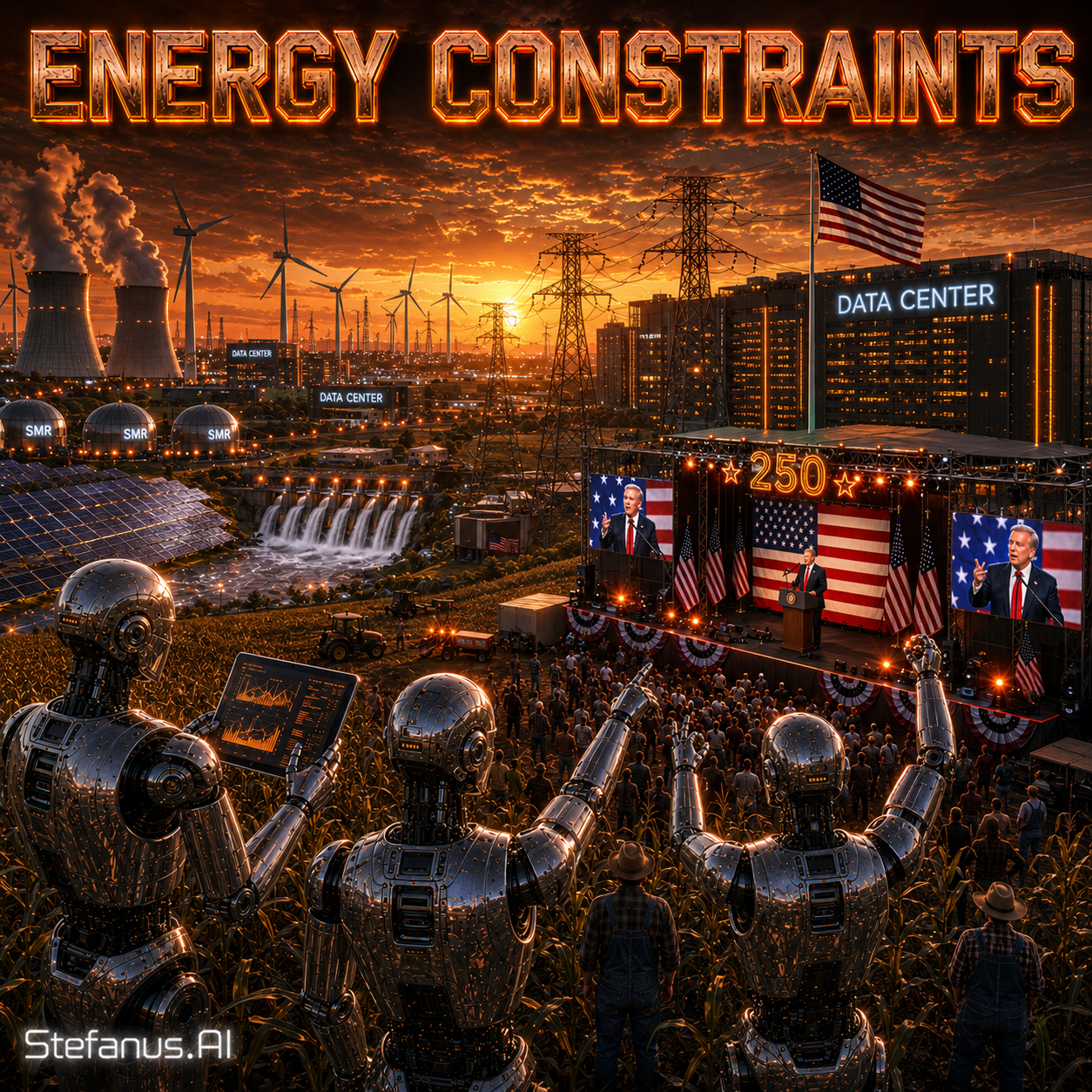

Introduction: Why Energy Constraints
On an ordinary American evening, the power grid feels invisible. A family turns on the air conditioning. A small business keeps its lights on. A hospital runs its imaging machines. A school charges laptops for the next morning. Somewhere else, behind a security fence, a new data center begins pulling electricity with the calm continuity of an industrial furnace. The building does not look dramatic from the highway. It may look like a warehouse, a logistics facility, or a low-slung concrete box with backup generators and cooling equipment. Yet inside that box, the new economy is being assembled: GPUs, networking fabric, liquid cooling, inference clusters, storage arrays, power distribution equipment, and the hidden machinery of artificial intelligence.
This is why the AI boom is not merely a software revolution. It is an energy revolution. It is a power-system revolution. It is also, increasingly, a political revolution. The American public first met generative AI as a browser window, a chatbot, a productivity tool, or an image generator. The infrastructure underneath looked weightless because the interface was weightless. But by 2026, the weight has become visible. Artificial intelligence now arrives as a substation request, a transmission upgrade, a water-permit dispute, a capacity auction price, a local zoning hearing, a power-purchase agreement, a nuclear restart, a ratepayer-protection bill, and a campaign argument over monthly utility bills.
The Department of Energy and Lawrence Berkeley National Laboratory reported that U.S. data-center electricity use rose from 58 terawatt-hours in 2014 to 176 terawatt-hours in 2023, and that data centers consumed about 4.4 percent of U.S. electricity in 2023, with projections ranging from 6.7 percent to 12 percent by 2028 under different growth scenarios.[1] The International Energy Agency similarly emphasized that data centers can be built far faster than energy infrastructure. A data center can reach operation in two or three years, while transmission lines, substations, power plants, and interconnection reforms often move on much longer timelines.[3] This timing mismatch is the first meaning of Energy Constraints: AI demand is accelerating at digital speed, while the grid still expands at industrial speed.
“The challenge is acute and urgent in the San Francisco Bay Area.”
— Liang Min, Stanford Bits & Watts Initiative [5]
A single large AI-oriented data center can consume as much electricity as a small city. MIT Energy Initiative has noted that a large data center can require the electricity equivalent of roughly 50,000 homes, while the World Resources Institute explains that a modern AI data center can use as much power as 100,000 homes, with the largest proposed facilities potentially far beyond that scale.[4][32] These comparisons are not rhetorical ornaments. They are attempts to translate invisible compute into civic language. When a data center arrives, the local grid does not see a chatbot. It sees load. It sees megawatts. It sees peak demand. It sees cooling requirements. It sees transformers, wires, switchgear, backup generation, water use, land use, and a new question for regulators: who should pay?
The title Energy Constraints captures a hard turn in the AI story. In the first phase of generative AI, attention concentrated on model size, training data, benchmark scores, talent wars, venture funding, and cloud platforms. In the second phase, the focus shifted toward chips, supply chains, export controls, GPU scarcity, and hyperscaler capital expenditure. The third phase, now unfolding in 2026, is different. It asks whether the physical economy can support the computational economy. It asks whether AI can scale without destabilizing local power markets. It asks whether innovation can remain socially legitimate when the public begins to connect data centers with higher bills, water usage, noise, or environmental strain.
The phrase also contains a double meaning. Energy constraints are physical constraints: power generation, transmission capacity, interconnection queues, grid reliability, cooling systems, land, water, and the scarcity of timely infrastructure. But energy constraints are also political constraints: rate design, utility regulation, local permitting, state tax policy, federal oversight, and the resistance of voters who do not want to subsidize the private compute estates of the largest technology firms. The grid collision is therefore not only a collision between AI and electricity. It is a collision between private speed and public infrastructure; between corporate capital expenditure and household affordability; between national AI ambitions and local utility bills; between digital abundance and physical scarcity.
This paper treats the AI energy collision as a new chapter in American political economy. The central question is not whether AI is important. It is. Nor is the question whether data centers are bad. They are not inherently bad. Data centers support cloud computing, scientific research, cybersecurity, productivity, digital services, and national competitiveness. The question is whether the next wave of AI infrastructure will be governed with a credible public compact. If the industry consumes power at unprecedented scale but leaves ordinary ratepayers to absorb hidden grid costs, public resistance will intensify. If the industry brings new generation, pays for incremental grid upgrades, uses flexible load, discloses environmental impacts, and respects local communities, the energy collision can become a new infrastructure bargain rather than a legitimacy crisis.
The outline of this paper follows that collision. Section 1 examines data-center sprawl and the physical logic of AI compute. Section 2 analyzes grid strain, wholesale price spikes, capacity markets, and cost allocation. Section 3 reviews the White House response, FERC actions, state measures, and the emerging ratepayer-protection framework. Section 4 examines how AI and energy moved unexpectedly into the 2026 midterm political environment. Section 5 explores the broader techlash: water, noise, land use, local control, and grassroots opposition. Section 6 distills the argument into five pillars. The conclusion returns to the title itself: Energy Constraints, the framework that explains why the future of artificial intelligence is now tethered directly to the future of the American power grid.

Section 1: Data Center Sprawl and the Physical Logic of AI Compute
The easiest mistake in discussing artificial intelligence is to imagine that it lives in the cloud. The word cloud is a triumph of metaphor and a failure of infrastructure literacy. There is no cloud without land. There is no inference without electricity. There is no model serving without cooling. There is no AI economy without a lattice of chips, fibers, transformers, substations, gas turbines, renewable projects, nuclear agreements, batteries, power electronics, water systems, and emergency backup equipment. The AI boom has made the geography of compute visible again because every model query ultimately lands somewhere physical.
Large language models and advanced multimodal systems have two energy profiles that matter. First, training requires enormous bursts of compute over concentrated periods. Second, inference converts AI into a continuous service, available to millions or billions of users, enterprise applications, software agents, robotics systems, search products, coding assistants, customer-service workflows, and industrial controls. The public often imagines AI energy demand as training demand, because training a frontier model sounds dramatic. But the long-term grid issue may be inference: the continuous, always-on, latency-sensitive serving layer that turns model intelligence into everyday economic activity.
The hardware has also changed the physics of the data center. GPU clusters pull dense electrical loads. They generate intense heat. They require high-bandwidth networking, stable power delivery, sophisticated cooling, and power architectures that can handle larger current swings and thermal stress. A 2026 technical review of next-generation AI data centers described how rising AI workloads are exposing limitations in traditional 48-volt rack architectures and low-voltage AC distribution, pushing research toward high-voltage conversion, facility-level low-voltage DC distribution, and medium-voltage solid-state transformers.[49] In other words, AI is not simply adding more servers. It is changing the design assumptions of the data-center electrical system itself.
This is the first layer of the Energy Constraints framework: density. Traditional enterprise data centers and cloud regions already used significant power, but AI clusters intensify the load per rack and the need for reliable, continuous electricity. A facility that looks like a warehouse from the outside can function like a new industrial plant from the perspective of the grid. It is not occasional load. It is not a seasonal mall. It is not a flexible household. It is a large, concentrated, often mission-critical demand source that may expect high capacity factors, low downtime, and robust backup systems.
The second layer is scale. Goldman Sachs Research projected that U.S. data-center power demand could more than double from 31 gigawatts in 2025 to 66 gigawatts in 2027, with the data-center share of U.S. peak demand rising from 4.1 percent to 8.5 percent over the same period.[6] The Department of Energy cited projections that U.S. data-center electricity use could reach hundreds of terawatt-hours by 2028.[1] The IEA reported that global data centers consumed around 415 terawatt-hours in 2024 and could approach 945 terawatt-hours by 2030 in its base case.[3] These numbers are estimates, and estimates vary, but the direction is unmistakable: AI infrastructure is moving from a marginal electrical customer into a structural force in power-system planning.
The third layer is regional concentration. Data-center demand is not spread evenly across the United States. It clusters where fiber, land, tax incentives, cloud ecosystems, power contracts, permitting, and customer proximity make development attractive. Northern Virginia remains the most famous example, but growth is spreading across Texas, Ohio, Georgia, Arizona, Nevada, Pennsylvania, Michigan, New Jersey, and other regions. A 2026 study on concentrated siting projected that North America, Western Europe, and Asia-Pacific would account for more than 90 percent of projected compute capacity in its scenario, and it identified regions such as Oregon, Virginia, and Ireland as vulnerable to high power-system stress when AI infrastructure concentrates too heavily.[46] The national electricity system may look large enough on paper, but local constraints can become acute.
The fourth layer is corporate acceleration. The earnings reports of the hyperscalers show that AI is not an abstract research priority. It is a capital-expenditure wave. Microsoft disclosed $34.9 billion in capital expenditures in its FY2026 first quarter and $37.5 billion in its second quarter, driven by cloud and AI infrastructure.[7][8] Alphabet reported Q1-2026 capital expenditures of $35.7 billion, with most of the spending tied to technical infrastructure for AI, and guided to dramatically higher full-year spending.[9] Meta reported Q1-2026 capital expenditures of $19.84 billion and raised its 2026 capex outlook to a range of $125 billion to $145 billion.[10] Amazon described a sharp increase in property and equipment purchases reflecting AI investments, while AWS continued to grow as the cloud platform underlying much of the AI economy.[11]
These disclosures matter because capital expenditure eventually becomes physical load. Every billion dollars of AI infrastructure is not a pure software expense. It becomes land, chips, buildings, mechanical systems, electrical gear, grid connections, transformers, generators, substations, power contracts, and cooling loops. Reuters reported that Amazon and Alphabet had issued tens of billions of dollars in bonds over the prior year, while hyperscaler capital expenditure was estimated at roughly $725 billion in 2026, nearly double the level of mid-2025.[12] Whether every forecast proves exact is less important than the strategic signal: the AI race is now being financed like a physical-industrial race.
The fifth layer is reliability. AI workloads do not merely need electricity; they need reliable electricity. A data center can buy renewable energy credits, sign power purchase agreements, and claim clean-energy alignment, but the physical load still requires instantaneous power. This is why AI infrastructure is increasingly linked to nuclear energy, gas generation, geothermal exploration, long-duration storage, grid-enhancing technologies, and onsite power. Google has described advanced nuclear as a source of clean, round-the-clock power for data centers and offices.[39] Meta announced nuclear energy agreements intended to support future AI infrastructure, with potential capacity additions over the next decade.[40] Amazon and Talen Energy expanded a nuclear power relationship at Susquehanna in Pennsylvania.[41] These transactions show that the largest technology firms now see power procurement as strategic infrastructure, not a facilities-management afterthought.
The sixth layer is cooling. Electricity demand cannot be separated from heat. Dense GPU clusters create thermal loads that require air cooling, liquid cooling, evaporative cooling, or hybrid strategies. Cooling choices shape electricity use, water use, site selection, operating cost, and community perception. The World Resources Institute noted that large data centers can require substantial water depending on cooling design and local conditions, while also emphasizing that water footprints vary by technology, climate, and power source.[32] Brookings similarly argued that AI data centers place pressure on local water infrastructure and require comprehensive regional planning rather than isolated project-by-project approvals.[34] The public hears about AI as intelligence, but communities experience it as heat, fans, water, substations, diesel generators, and land conversion.
“AI’s demand for power is an order of magnitude larger than what we have seen in traditional data centers.”
— Richard Michelfelder, Rutgers University Camden [38]
The seventh layer is uncertainty. Nobody knows the exact trajectory of AI demand. Future model architectures may become more efficient. Specialized chips may reduce energy per token. Inference optimization may lower costs. Better scheduling may shift flexible workloads away from peak hours. But the opposite is also possible: AI agents could multiply usage, video models could increase compute intensity, robotics and industrial AI could move workloads from optional use into continuous operations, and enterprise adoption could turn AI into a default layer of software. The grid must plan under uncertainty, but the consequences of underbuilding and overbuilding are both expensive.
This is why the phrase data-center sprawl is useful but incomplete. Sprawl suggests land consumption, and that is part of the story. Yet AI infrastructure is also a sprawl of obligations: transmission obligations, capacity obligations, water obligations, emissions obligations, financing obligations, political obligations, and social-license obligations. The American power system is being asked to absorb a new class of customer whose appetite is large, concentrated, fast-growing, and strategically important. The grid can support this growth only if the cost, timing, and location of AI infrastructure are governed with more precision than the first phase of the boom allowed.
1.1 The Infrastructure Stack Beneath a Single AI Query
To understand the Energy Constraints framework, one must follow a single AI query backward through the stack. The user sees an answer on a screen. Behind that answer is inference software, a model checkpoint, a GPU or accelerator cluster, a scheduler, memory, networking, storage, cooling, power distribution, building systems, substations, transmission lines, generation resources, and fuel or renewable availability. The interface is instantaneous because the infrastructure is pre-positioned. The user experiences latency in milliseconds, while the power system experiences investment cycles in years.
This stack is why AI infrastructure behaves differently from earlier digital services. Search, streaming, social media, and enterprise cloud all required large data centers, but generative AI raises the density and urgency of demand. A coding assistant, a customer-service agent, a legal-document system, a drug-discovery platform, a design tool, a video model, and a robotics planner may all require inference at different times of day and with different latency requirements. The data center becomes not a storage vault but a real-time intelligence factory.
The most important policy question is not only how much electricity AI uses in annual terms, but how it uses electricity by hour, by location, and by operational priority. A training job may be schedulable. Some batch inference may be deferable. But consumer-facing inference, search, cloud APIs, and mission-critical enterprise workloads may be far less flexible. This distinction matters because flexible load can help the grid, while inflexible peak load can make the grid more expensive. MIT’s 2026 work on data-center flexibility directly targets this distinction by asking how large loads can be added without increasing peak usage.[37]
The 100-megawatt data-center example in the introduction is therefore not only a size comparison. It is a governance problem. If a 100-megawatt facility arrives in a region with spare capacity, robust transmission, and a clear tariff, it may be manageable. If the same facility arrives near a constrained substation, in a region with limited new generation, with rate structures that socialize costs, it can become a political event. The megawatt number is the same. The institutional context is different.
1.2 From Chip Scarcity to Power Scarcity
The AI boom began with a chip bottleneck. Companies competed for GPUs, advanced packaging, high-bandwidth memory, networking equipment, and cloud access. By 2026, the chip bottleneck had not disappeared, but the strategic bottleneck widened. A GPU without power is stranded capital. A data-center shell without interconnection is a real-estate asset, not an intelligence asset. A cloud region without cooling and backup reliability is a promise, not capacity.
Corporate earnings make this transition visible. Microsoft, Alphabet, Meta, and Amazon are spending at levels that resemble an industrial buildout rather than a conventional software cycle.[7][8][9][10][11] The market often reads these disclosures as proof of AI demand. Energy policy reads them as future load. Every announced data-center campus is a signal to transmission planners, generation developers, water authorities, local officials, and consumer advocates.
This is why AI companies are increasingly negotiating directly for power resources. Nuclear agreements, renewable contracts, onsite generation, grid services, and battery strategies are not public-relations accessories; they are business-continuity tools.[39][40][41] The company that cannot secure reliable power cannot fully monetize its model pipeline. The model roadmap and the power roadmap are converging.
The deeper strategic lesson is that compute advantage now includes energy advantage. A nation with chips but without power cannot scale AI. A state with incentives but without transmission cannot host it sustainably. A company with models but without megawatts cannot serve customers at scale. Energy Constraints names this convergence: power is becoming part of the AI stack itself.

Section 2: Grid Strain and Cost Allocation
The grid collision becomes politically explosive when the public believes that private data-center growth is being socialized through public utility bills. Electricity systems are not ordinary markets. They are regulated networks built over decades, financed through rate structures, maintained through reliability obligations, and planned through processes that were never designed for sudden clusters of gigawatt-scale AI load. When a new large customer connects, someone must pay for the generation, transmission, distribution, interconnection, reserves, and reliability measures needed to serve it. The central conflict is not simply demand. It is cost allocation.
Capacity markets have made this conflict visible. PJM Interconnection, which operates the largest U.S. wholesale power market, reported that its 2026/2027 capacity auction cleared at the FERC-approved cap of $329.17 per megawatt-day, following the prior year’s $269.92 per megawatt-day result.[14] IEEFA highlighted the dramatic increase by comparing PJM capacity prices with much lower levels in earlier auctions, describing how projected data-center growth contributed to a tenfold capacity-price surge in the region.[16] Capacity prices are not the same as retail bills, but they feed into the cost stack that utilities and consumers eventually confront. They are a signal that reliability commitments have become more expensive under conditions of tight supply and rising load.
The often-cited claim that wholesale electricity costs near data-center activity surged by as much as 267 percent needs careful handling. The figure has circulated because it is vivid and politically powerful. But the precise interpretation matters. Fact-checking and reporting tied to the Bloomberg analysis clarified that the 267 percent figure referred to wholesale electricity prices near certain data-center hotspots compared with levels five years earlier, not a direct statement that household bills rose by 267 percent.[17] This distinction is essential. A serious paper should not collapse wholesale market prices into retail bills. But it should also not dismiss the concern, because wholesale price spikes, capacity costs, transmission upgrades, and utility rate cases can eventually shape what households and small businesses pay.
Maryland’s Office of People’s Counsel has made the ratepayer concern explicit. It argued that data-center growth is driving costs through capacity, transmission, and energy markets, and it pointed to transmission projects advanced to accommodate Northern Virginia data-center growth, with some costs potentially allocated across neighboring customers.[15] The policy issue is therefore regional. A data center may sit in one state, but the transmission upgrades and capacity-market consequences may be spread across a larger footprint. That makes the fairness question harder: if one jurisdiction captures the tax base and jobs, why should another jurisdiction’s customers help pay for the grid expansion?
Cost allocation is especially sensitive because U.S. electricity affordability was already strained before the AI boom. Reuters, drawing on analysis from Columbia University’s Center on Global Energy Policy, argued that data centers are being blamed for a broader power-system affordability problem rooted in outdated policy, rising equipment costs, utility incentives, and inefficient grid management.[18] This critique is important because it avoids a simplistic villain story. Data centers are not the only reason electricity bills rise. Inflation, fuel costs, aging infrastructure, severe weather, electrification, transmission bottlenecks, and utility capital incentives all matter. But data centers can accelerate and localize existing stress. They can turn a manageable planning problem into an urgent public controversy.
“How can we add them to the network without adding a lot to our peak usage?”
— Christopher Knittel, MIT [37]
Peak demand is the key. A data center that consumes electricity steadily may raise total energy consumption, but a data center that adds to system peak can force expensive investments in generation and grid capacity that are used only during constrained hours. MIT researchers have therefore focused on flexibility: can data centers shift workloads, modulate demand, use batteries, co-locate generation, or participate in demand response so they do not intensify peak constraints?[37] The difference between average demand and peak demand is the difference between a large customer that pays its way and a large customer that triggers a costly reliability problem.
This is the second reason Energy Constraints is the right title. The constraint is not simply megawatt-hours. It is timing. It is location. It is deliverability. It is the ability of wires, substations, transformers, generation resources, and market rules to serve load when and where it appears. A national estimate may say the grid can absorb more demand, while a local utility says a substation cannot. Both can be true. A state may welcome data-center investment, while a town rejects a particular project because of water use, noise, or diesel backup generators. Both can be true. A company may purchase enough renewable energy on an annual basis, while the grid still needs firm capacity on a hot evening. Both can be true.
The grid does not reward slogans. It rewards physics and accounting. If a hyperscaler signs an annual renewable contract but uses grid power during peak hours when fossil generation is marginal, the system still faces peak and emissions consequences. If a utility builds transmission to serve a cluster of AI loads and spreads the cost to residential customers, the project may become politically toxic even if it improves long-run capacity. If a data center promises jobs but only produces a small permanent workforce after construction, local voters may see the bargain as uneven. If the public learns that corporate AI infrastructure is increasing utility costs, the legitimacy of AI itself can erode.
The IMF’s 2025 working paper framed the issue at a macroeconomic level, warning that AI-driven data-center expansion could raise electricity prices and emissions when renewables and transmission remain constrained.[19] That insight connects household bills to national productivity. AI may increase productivity, but the productivity dividend can be weakened if the infrastructure required to support AI raises energy costs across the economy. This is the economic paradox of the grid collision: a technology that promises efficiency may require an infrastructure buildout that first produces scarcity.
The World Bank’s 2025 AI foundations report adds another dimension. It treats AI and data infrastructure as development foundations, but it also warns that data centers are capital and energy intensive, placing heavy demands on local power grids and land markets, while tax exemptions may affect electricity prices and public revenues.[44][45] That framing matters for the United States as well. A data center can be an economic-development project, a cloud-infrastructure asset, a national competitiveness asset, and a burden on local infrastructure at the same time. Public policy must hold all four truths together.
The cost-allocation debate therefore has three layers. The first is causation: what portion of new grid cost is caused by data centers, electrification, aging infrastructure, or ordinary load growth? The second is responsibility: should the cost be borne by the data center, by all customers, by the utility shareholder, by taxpayers, or by some combination? The third is transparency: can regulators and the public see enough information to judge whether large-load contracts are fair? Without transparency, even efficient projects can lose legitimacy because voters suspect hidden subsidies.
Ratepayer anger is not only an economic reaction; it is a moral reaction. People accept paying for schools, hospitals, local roads, and shared infrastructure when they believe the benefit is public. They resist paying for infrastructure that appears to enrich a small group of private companies while offering limited local benefit. The AI industry therefore faces a social-license problem. It can win the engineering race and lose the public bargain. The core question is whether the American power equation can be rewritten so that AI companies pay for the incremental costs they create, bring new clean or firm power to the grid, and offer flexibility that helps rather than harms reliability.
2.1 The Hidden Architecture of the Monthly Bill
Retail electricity bills are simplified summaries of a complex cost architecture. They can include energy costs, capacity costs, transmission charges, distribution charges, fuel adjustments, storm recovery, public-benefit programs, taxes, and utility returns on capital investment. When data-center demand enters this architecture, the causal chain becomes difficult for the public to see. A customer may not know whether a bill increase reflects fuel prices, storms, new transmission, utility profit, capacity-market stress, or data-center growth.
That opacity is politically dangerous. If voters cannot identify the cause of higher bills, they may accept the simplest story available. In 2026, the simplest story is that Big Tech is using the grid and households are paying. The story is sometimes incomplete, but it gains power because the billing architecture is hard to explain. Transparency does not eliminate conflict, but it reduces the space in which suspicion grows.
PJM’s capacity-market experience illustrates the problem. Capacity prices are not retail rates, but they influence the total cost of serving customers. When the clearing price rises sharply, utilities, regulators, and consumer advocates must explain how those costs flow into bills. PJM itself estimated that retail bill impacts would vary depending on pass-through and jurisdictional rules.[14] IEEFA emphasized the magnitude of the capacity-price increase, while consumer advocates connected regional transmission and capacity decisions to household exposure.[16][15]
A responsible analysis must therefore reject two extremes. It is wrong to claim that AI data centers alone explain every utility bill increase. It is also wrong to claim that data centers are irrelevant because bills are complex. The correct view is that data centers are a new large-load accelerant inside a system already under stress. They are not the only fire, but they are adding heat.
2.2 The Political Economy of Stranded Costs
Stranded cost risk is one of the most underappreciated issues in the AI infrastructure boom. Utilities may build or upgrade assets to serve projected data-center load. If the customer delays, scales down, relocates, or cancels, the infrastructure cost may remain. If that cost enters the regulated asset base, ordinary customers may pay for capacity that was built for a private project that never fully materialized.
Harvard’s Belfer Center has warned that financing and stranded-asset risks deserve attention because demand projections remain uncertain and infrastructure investments are long-lived.[13] This is particularly important in AI, where model efficiency, chip design, regulatory constraints, enterprise adoption, and competitive dynamics can change faster than utility planning assumptions. A region could overbuild for a demand scenario that fails to arrive, or underbuild for a demand scenario that arrives suddenly. Both errors are costly.
The solution is not paralysis. It is contract discipline. Large-load agreements should include deposits, minimum bills, exit fees, ramp schedules, security requirements, and cost-causation protections that reduce the risk of stranded infrastructure. If a data-center developer asks a public utility to prepare capacity, the developer should carry meaningful financial responsibility. This principle is not anti-growth; it is pro-accountability.
Stranded cost risk also complicates political messaging. A data-center project may be announced with impressive investment numbers, but investment headlines do not guarantee long-term public benefit. Policymakers should ask how many permanent jobs will remain, how much tax revenue will materialize after abatements, what infrastructure must be built first, and who pays if the project changes. The AI economy rewards speed, but public infrastructure requires durable obligations.

Section 3: The White House Response and the New Ratepayer Compact
By 2026, the federal response had begun to shift from celebration of AI investment to management of AI infrastructure externalities. The White House, FERC, DOE, Congress, state legislatures, and utility regulators all began operating in the same conceptual space: AI infrastructure is strategically important, but it cannot be allowed to destabilize household electricity affordability or grid reliability. This is the beginning of what can be called the new ratepayer compact.
The White House Ratepayer Protection Pledge crystallized the new language. It asked participating companies to build, bring, or buy new generation; pay for the delivery infrastructure needed to support data centers; and negotiate separate rate structures so costs would not be passed to households.[23] The pledge was voluntary, and voluntary commitments are not the same as enforceable tariffs. Yet the political symbolism was significant. It marked a transition from the assumption that hyperscalers could simply connect to the public grid like ordinary customers, toward the expectation that massive AI loads must arrive with a credible power plan.
The most important phrase in this policy shift is cost causation. In utility regulation, cost causation means customers should pay for the costs they cause. Applied to AI data centers, the principle sounds simple: if a data center requires new transmission, substations, reliability upgrades, or dedicated generation, the data center should bear a fair share of those costs. But implementation is difficult because grid upgrades often benefit multiple customers over time. A transmission line built for one cluster may later support broader growth. A capacity resource may improve system reliability for everyone. A data-center contract may involve confidential commercial terms. Regulators must balance fairness, speed, transparency, and investment.
“Ratepayers should not have to subsidize wealthy corporations’ growing energy demands.”
— Kathy Castor, U.S. Representative [24]
Congressional action followed the same logic. The bipartisan Ratepayer Protection Act, introduced in June 2026 by Representative Kathy Castor and Representative Gabe Evans, sought to protect families from costs associated with new data centers by directing state regulators to ensure that communities do not pay for new generation, transmission, and grid upgrades caused by these projects.[24] The bill’s significance lies not only in its substance but in its bipartisan framing. Data-center cost allocation is not easily contained inside a conventional partisan category. Rural communities, suburban voters, industrial states, environmental groups, consumer advocates, utilities, tech firms, and economic-development agencies can all find reasons to care.
FERC’s actions show that the federal regulator understands the urgency. In June 2026, FERC launched a targeted effort requiring regional grid operators to justify or reform tariffs for large load integration, including data centers and other large users, with explicit attention to protecting ratepayers.[20] Earlier, FERC directed PJM to create clearer rules around co-located loads and data centers, finding that a lack of clarity created uncertainty around how large loads connect, use behind-the-meter generation, and interact with wholesale markets.[21] These actions are technical, but their implications are political: the grid cannot handle AI growth through ad hoc bilateral deals alone. It needs transparent rules.
“Clarifying new rules will help release the bottleneck.”
— Laura V. Swett, FERC Chair [21]
DOE also entered the emergency-management side of the story. Its 2026 emergency orders under section 202(c) authorized targeted backup generation and demand measures in PJM under severe reliability conditions, including reference to data centers and large loads as last-resort resources before the most serious emergency actions.[22] This is a remarkable sign of the times. Data centers are no longer merely customers in the background. They are becoming actors in reliability planning. Their backup generators, flexible load, onsite generation, and operational choices may become part of grid emergency strategy.
PJM’s expedited interconnection track further illustrates the tension between speed and safeguards. FERC approved a temporary PJM process to fast-track large-capacity projects, with a limited number of interconnection requests, minimum capacity thresholds, and requirements for projects to become operational within defined timelines.[50] This reflects the pressure to add generation quickly. But speed can create its own political risk if communities believe the grid is being redesigned for private AI infrastructure without adequate public review.
“The electrical grid needs new generation as quickly as possible.”
— David Mills, PJM [50]
State governments are moving as well. MultiState tracked more than 300 data-center bills across more than 30 states early in 2026, showing a rapid shift from incentive-driven policy toward regulation, transparency, taxation, environmental reporting, and ratepayer protection.[25] A later MultiState analysis found that federal AI data-center policy was meeting resistance from state lawmakers, with bills addressing water reporting, moratoria, and local impacts.[26] Oklahoma advanced a Data Center Consumer Ratepayer Protection Act to shield families and small businesses from higher utility costs tied to data-center development.[27] Virginia lawmakers approved a first-of-its-kind data-center power tax aimed at balancing the state’s large data-center footprint with public concerns about energy use and local impacts.[28]
This state-level activity reveals a profound change in the politics of data centers. For years, states competed to attract them with tax incentives, land, expedited permitting, and friendly utility arrangements. Data centers were framed as symbols of modernity: cloud infrastructure, digital jobs, clean industrial growth, and technological relevance. By 2026, the frame had changed. Data centers still symbolize modernity, but they also symbolize power scarcity, public subsidy, water concern, noise, and local loss of control. The same facility can be marketed by one office as economic development and opposed by residents as an unwanted industrial load.
The new ratepayer compact therefore has five elements. First, transparency: regulators must know what large-load customers are paying and what costs are being shifted. Second, additionality: AI companies should help bring new power resources to the system rather than merely bidding against households for existing capacity. Third, deliverability: power claims should match the physical grid, not just accounting instruments. Fourth, flexibility: data centers should be encouraged or required to reduce, shift, or self-supply during peak and emergency conditions where feasible. Fifth, accountability: projects should disclose environmental impacts, water use, backup generation, and local costs in a way communities can understand.
This does not mean every data center must build its own power plant. The grid is a shared system, and shared systems can be more efficient than isolated private microgrids. But it does mean the old model of quietly absorbing large new loads into utility planning and spreading the costs broadly is no longer politically stable. The AI boom is too large, too visible, and too strategically consequential. The public will ask who benefits, who pays, who decides, and who bears the environmental costs. Any serious federal response must answer those questions before distrust hardens into permanent opposition.
The White House pledge, FERC tariff proceedings, congressional bills, state legislation, and utility-rate debates together mark a paradigm shift. AI companies are being moved from passive grid customers toward active infrastructure participants. They are expected to be buyers, builders, flexible loads, and sometimes co-located power partners. The public utility grid remains essential, but the new assumption is that AI infrastructure cannot treat public capacity as an unlimited free platform. This is the policy expression of Energy Constraints: innovation can scale only when its physical costs are governed.
3.1 Federalism and the Fragmented Grid
The American power system is difficult to govern because authority is fragmented. Federal agencies oversee interstate transmission, wholesale markets, reliability, emergency orders, and certain environmental or energy-security questions. States regulate retail utilities, siting, resource planning, tax incentives, local land-use authority, and consumer protection. Regional transmission organizations coordinate markets in some areas but not others. Municipalities and counties control zoning in many cases. Data-center developers navigate this fragmented system strategically.
Fragmentation can be a strength because it allows local adaptation. It can also become a weakness when a fast-moving national industry exploits gaps between jurisdictions. One state may approve incentives. Another may carry transmission costs. A county may approve zoning before a utility has solved interconnection. A federal policy may encourage AI leadership while state lawmakers respond to water and ratepayer backlash. The result is not a single national AI energy policy; it is a patchwork.
FERC’s 2026 proceedings can be read as an attempt to create more coherence inside that patchwork. By asking regional grid operators to justify large-load integration rules, FERC is not dictating every local siting decision. It is trying to ensure that tariffs and interconnection rules do not allow large loads to create hidden costs or reliability risks.[20] This is federalism under stress: national competitiveness requires speed, but public legitimacy requires rulemaking.
The White House pledge has similar limits. It creates a national expectation but depends on voluntary compliance and state-level implementation.[23] MultiState’s tracking of state legislation shows that lawmakers are not waiting for a single federal solution.[25][26] They are experimenting with reporting requirements, ratepayer protections, taxes, moratoria, and local-control measures. This experimentation may be messy, but it reflects a system trying to adapt to a new infrastructure category.
3.2 The New Bargain: Build, Bring, Buy, or Bend
The emerging policy bargain can be summarized in four verbs: build, bring, buy, or bend. Build means the data-center operator or its partners help finance new generation and grid infrastructure. Bring means the project arrives with a credible dedicated power plan, such as co-located generation, new power-purchase agreements, or firm clean resources. Buy means the company procures power and capacity in a way that reflects its incremental system cost rather than relying on subsidized rates. Bend means the load becomes flexible enough to reduce peak demand or support reliability during emergencies.
These verbs capture the movement from passive consumption to active system participation. A traditional commercial customer simply buys electricity under a tariff. A hyperscale AI customer may need to do more because its scale is closer to industrial infrastructure than ordinary commercial service. This does not eliminate the role of utilities; it changes the responsibilities attached to large new loads.
The most promising future is not a world in which every data center isolates itself from the grid. Fragmented private energy islands could reduce shared efficiency and complicate reliability planning. The better model is integrated accountability: data centers remain connected to the grid but pay the costs they cause, bring additional resources, use flexibility where possible, and operate under transparent rules. That is the difference between an AI load that strains the grid and an AI load that strengthens it.

Section 4: Midterm Election Fallout
Energy politics usually becomes national politics when it reaches the household bill. A transmission constraint is technical. A capacity market is technical. A power-purchase agreement is technical. But a rising monthly utility bill is not technical. It is emotional, visible, repeated, and impossible for families to ignore. By 2026, AI and data centers had moved from specialist policy circles into the midterm political environment because the public began to connect digital infrastructure with the cost of living.
The Associated Press described utility bills and AI data centers as emerging issues in the 2026 election environment, with voter anger over affordability intersecting with concerns about data centers in competitive states such as California, Georgia, Michigan, Ohio, Pennsylvania, and Texas.[29] This does not mean data centers will determine the election. It means they have become available as a campaign symbol. In politics, symbols matter. A data center can stand for Big Tech, rising costs, water stress, local exclusion, and unfair subsidy all at once.
The electoral issue is powerful because it crosses ideological boundaries. A conservative voter may object to government-enabled corporate subsidy, land-use disruption, or unreliable energy planning. A progressive voter may object to environmental impacts, water use, corporate concentration, or regressive utility bills. A suburban homeowner may object to noise and property-value concerns. A small-business owner may object to higher electricity costs. A union worker may support construction jobs but still demand local benefits. A governor may want investment while a county commissioner faces angry residents at a zoning hearing. AI energy politics is not a clean partisan script; it is a rogue infrastructure issue that touches many constituencies at once.
Michigan provides a vivid example of how data-center opposition can enter electoral messaging. WIRED reported that anti-data-center organizing had become part of Michigan political discourse, with local candidates discussing moratoria, energy costs, and community control.[31] The details of any one race should be treated carefully, but the pattern is important. Data centers have become local political objects. They are not merely approved through back-office economic-development negotiations. They are argued over in public meetings, campaign events, and local media.
Virginia is another critical case because it combines national AI infrastructure importance with concentrated local impacts. Northern Virginia’s data-center ecosystem is central to the modern internet, and Harvard’s Belfer Center has noted the scale of data-center capacity in the state.[13] Yet Virginia also illustrates the backlash cycle: tax incentives attract facilities, facilities drive power and land concerns, voters question who benefits, and lawmakers consider new taxes or regulatory structures.[28] This is the mature phase of the data-center bargain, when the original promise of investment meets the accumulated cost of scale.
New Jersey, Pennsylvania, Georgia, Ohio, Texas, and other states face related dynamics. Some communities want data-center investment because it can expand the tax base, support construction employment, modernize local infrastructure, and align a region with the AI economy. Other communities oppose projects because they fear noise, water consumption, diesel backup generators, transmission corridors, limited permanent jobs, or rising rates. Many communities are internally divided. The same project can be described by supporters as a once-in-a-generation economic-development opportunity and by opponents as an extractive industrial installation.
The midterm significance lies in the translation of infrastructure into kitchen-table language. Voters do not need to understand PJM capacity auctions to understand higher bills. They do not need to understand transformer procurement to understand a utility rate increase. They do not need to understand GPU clusters to understand a zoning hearing. Data centers make AI physical enough to campaign against or campaign around. That is why the issue can travel quickly from local planning boards to statehouses to congressional races.
Polling suggests that public opposition is not marginal. Gallup reported in May 2026 that roughly seven in ten Americans opposed having AI data centers in their area, with opposition rooted in concerns over resources, water, energy and grid strain, and quality of life.[30] Polls are snapshots, not destiny. Public opinion can shift if projects bring visible local benefits, pay their costs, disclose impacts, and respond to community concerns. But the Gallup result is a warning: the AI industry cannot assume that national enthusiasm for technology automatically creates local consent for infrastructure.
The politics are sharpened by timing. The 2026 midterms arrive after several years of public anxiety about inflation, housing costs, insurance costs, and energy costs. In that environment, even a technically defensible rate increase can become politically dangerous. If a voter believes the increase is linked to giant technology firms, the anger intensifies. The issue does not require voters to reject AI. They can use AI tools and still oppose nearby data centers. They can admire American technological leadership and still object to paying for private infrastructure through monthly bills.
This is where Energy Constraints becomes an electoral framework. Energy constraints are not just constraints on technology; they are constraints on political tolerance. A society may support innovation until the costs become visible, local, and unfairly distributed. Midterm politics will not be decided by grid engineering papers, but grid engineering papers can explain why the issue reached the ballot environment. The timing mismatch, cost-allocation opacity, and local concentration of impacts created the conditions for voter mobilization.
A neutral analysis should avoid overstating the case. Data centers are one factor among many in utility costs. Some regions with major data-center investment may manage costs effectively. Some projects may bring substantial local revenue. Some opposition may be driven by misinformation or generalized distrust of technology. But the political reality remains: when an infrastructure system is already strained and a new class of corporate load arrives visibly, voters will demand accountability. The midterm fallout is not simply anti-AI sentiment. It is a demand for a new public bargain around who pays for the power equation.
4.1 Why Local Anger Travels Nationally
A local data-center dispute can become a national political symbol because it contains several anxieties at once. It is about affordability, because people fear higher bills. It is about environment, because people fear water use and emissions. It is about democracy, because people fear decisions made without them. It is about inequality, because people see enormous corporate wealth. It is about land, because people see industrial structures entering rural, suburban, or exurban landscapes. It is about technology, because people suspect AI will change work and society faster than communities can govern.
This clustering of anxieties makes data centers politically potent. A campaign message does not need to explain transformer procurement or reserve margins. It can point to a facility, a bill increase, a tax incentive, or a zoning vote and say: this is what unaccountable technology looks like. Whether the message is fully accurate is a separate question. Politically, the visibility of the facility matters.
The issue is also portable because many states are experiencing similar debates. The details vary, but the pattern repeats: a project is announced; supporters emphasize investment and tax base; opponents raise power, water, noise, and local-control concerns; utilities discuss interconnection; lawmakers propose reporting or ratepayer-protection measures; and media connect the local dispute to the national AI boom. This repetition turns isolated fights into a broader political narrative.
A neutral analysis should note that communities may choose different bargains. Some may accept data centers if they produce tax revenue for schools, fund grid upgrades, guarantee water protections, and disclose impacts. Others may reject them because the perceived costs exceed the benefits. The point is not that one answer fits every community. The point is that the old assumption of automatic local consent has ended.
4.2 The Midterm Language of Affordability
Affordability is the bridge between energy policy and electoral politics. Electricity bills are not abstract. They arrive every month. They affect renters, homeowners, seniors, small businesses, schools, churches, and local governments. When electricity becomes more expensive, every other budget line feels tighter. That is why data-center politics can attach itself to a larger cost-of-living debate.
The AP’s reporting placed AI data centers within this affordability frame for the 2026 midterm environment.[29] Gallup’s polling showed strong local opposition to AI data centers, suggesting that the issue has moved beyond specialist circles.[30] WIRED’s Michigan reporting showed how local organizing can become campaign language.[31] These are not predictions of a single election outcome. They are evidence that the infrastructure footprint of AI is becoming visible to voters.
The risk for the AI industry is that it becomes associated with extraction rather than opportunity. If communities believe the industry extracts electricity, water, land, and subsidies while providing limited local value, political resistance will widen. If communities see concrete benefits – tax revenue, grid investment, clean power, workforce opportunities, water safeguards, and transparent commitments – the politics can become more balanced.

Section 5: The Broader Techlash and Grassroots Opposition
The data-center backlash is part of a broader techlash, but it is not identical to earlier forms of techlash. Previous waves focused on privacy, misinformation, monopoly power, labor displacement, screen addiction, content moderation, and platform governance. The data-center backlash is more material. It is about electricity, water, land, noise, diesel generators, transmission corridors, substations, tax abatements, and community consent. It turns Big Tech from a screen into a neighbor, and sometimes an unwelcome one.
Grassroots opposition often begins with a sense of procedural exclusion. Residents discover that a large facility is planned near them, that negotiations occurred before the community understood the project, or that local officials framed the project primarily as economic development. People then ask basic questions: how much power will it use? Who pays for grid upgrades? How much water will it consume? How loud will cooling equipment be? Will backup generators run during tests or emergencies? How many permanent jobs will remain after construction? What tax incentives were offered? What happens if the project is canceled after infrastructure is built?
Water has become one of the most visible flashpoints. The World Resources Institute noted that data-center water use varies substantially by cooling technology, local climate, and electricity source, but that large facilities can impose significant local demands, especially when many projects cluster in water-stressed regions.[32] Brookings argued that local water infrastructure can be burdened by AI data centers and that planning should occur regionally rather than through isolated approvals.[34] Cornell researchers projected that rapid AI data-center growth could create substantial increases in carbon and water footprints by 2030 if siting, decarbonization, and efficiency are not improved.[33]
“AI is changing every sector of society, but its rapid growth comes with a real footprint.”
— Fengqi You, Cornell University [33]
The environmental accounting problem is complicated. A data center’s direct water use may be lower than some agricultural or industrial uses, but indirect water use through electricity generation can be significant. An air-cooled facility may reduce direct water use but consume more electricity for cooling. A water-cooled facility may reduce electricity use but raise local water concerns. A renewable power contract may reduce annual emissions accounting but not solve local grid capacity constraints. A nuclear agreement may supply firm low-carbon power but raise questions about timing, cost, safety, and regulatory complexity. Every solution contains trade-offs. Communities often distrust projects because those trade-offs are not explained early or clearly enough.
Noise is another localized impact. Large cooling systems, backup generators, transformers, and constant operations can affect nearby residents even when the facility itself is visually plain. Noise complaints often become proxies for a deeper concern: residents feel that the data center extracts value from their community while the benefits flow elsewhere. The servers may serve global customers, the tax agreements may favor corporate investment, the jobs may be temporary, and the electricity costs may be shared. This perceived asymmetry fuels opposition.
The United Nations and United Nations University have pushed the environmental-accountability frame globally. UNU-INWEH characterized AI as a material system with environmental costs across energy, carbon, water, and land footprints, calling for transparency, efficiency, equity, and lifecycle responsibility.[35] Reuters reported that UN Secretary-General António Guterres called on AI firms to disclose environmental costs and power data centers with renewable energy by 2030.[36]
“If AI is to help build a better future, it must be honest about what it costs us now.”
— António Guterres, United Nations Secretary-General [36]
Transparency is the bridge between environmental concern and public trust. Communities do not need perfect certainty, but they need credible disclosure. They need to know the range of power demand, the expected water use, the backup generation plan, the emissions profile, the tax incentives, the ratepayer protections, and the infrastructure obligations. Without disclosure, even a relatively responsible project can be interpreted as a hidden corporate deal. With disclosure, a community can negotiate benefits, safeguards, monitoring, and enforceable commitments.
The techlash also reflects wealth perception. The public sees the largest technology companies generating extraordinary market capitalization, issuing large bonds, and spending hundreds of billions on AI infrastructure.[12] At the same time, households may be struggling with utility bills. When those two facts coexist, a political narrative forms: ordinary families are paying more so that trillion-dollar companies can build AI empires. That narrative may be incomplete, but it is emotionally powerful. The industry cannot defeat it with public-relations slogans. It must answer it with rate structures, local benefits, and transparent cost allocation.
There is also a legitimacy problem in the phrase artificial intelligence itself. AI promises to increase productivity, improve medicine, accelerate science, enhance education, strengthen defense, and automate routine work. But when people see data centers as energy-hungry and water-intensive, they may ask whether the benefits are real, broadly shared, or primarily captured by the tech elite. If AI is framed as a public good but experienced as a private load, trust erodes. The energy debate therefore becomes a referendum on the social purpose of AI.
The World Bank’s AI development framework is useful here because it does not treat AI infrastructure as purely private technology. It frames digital and AI infrastructure as part of broader institutional capacity, economic opportunity, safeguards, and inclusive development.[44] Applied to the United States, this suggests that data-center policy should not be left solely to corporate site-selection teams and utility interconnection queues. It belongs in democratic infrastructure planning. Communities should be able to ask whether the AI infrastructure being built near them supports public goals, not merely private compute demand.
The broader techlash is not inevitable anti-technology sentiment. It is a governance failure signal. Communities are not necessarily rejecting cloud computing, AI research, or digital services. They are rejecting surprise, asymmetry, and unfairness. They are rejecting the idea that technological inevitability should override local accountability. If the industry learns from this resistance, the next phase of data-center development could be more transparent, flexible, and community-oriented. If it ignores the resistance, every new facility may become another symbol of the grid collision.
5.1 From NIMBYism to Infrastructure Citizenship
It is tempting to label every local objection as NIMBYism, but that label is often analytically lazy. Some opposition is indeed reflexive. Some objections may misunderstand technical details. But many communities are asking legitimate infrastructure questions that developers and policymakers should answer. How much power? How much water? Who pays? What happens during emergencies? What is the noise profile? What are the tax terms? What local benefits are guaranteed? These are not anti-technology questions. They are citizenship questions.
Infrastructure citizenship means treating communities as stakeholders in the AI economy rather than obstacles to be managed. A community hosting a large data center is hosting part of the national intelligence infrastructure. It deserves information, safeguards, and negotiated benefits. This is not simply a moral point; it is a practical point. Projects that earn trust are less likely to face delays, lawsuits, moratoria, and political backlash.
The United Nations and UNU framing of environmental accountability reinforces this idea.[35][36] AI firms should not treat environmental disclosure as reputational charity. Disclosure is part of the social license to operate. The more powerful AI becomes, the more legitimacy it requires. The energy, carbon, water, and land footprint of AI is not an external footnote; it is part of the technology’s public meaning.
Sustainability in this context must be local and temporal. Annual renewable matching is not enough if local peak constraints worsen. Corporate water-positive goals are not enough if a specific watershed is stressed. National economic-development language is not enough if a town absorbs noise and grid risk without benefit. AI infrastructure needs a more granular standard of responsibility.
5.2 The Coming Design Principles for Responsible AI Infrastructure
Responsible AI infrastructure will likely be judged by several design principles. First, additionality: does the project bring new clean or firm capacity rather than merely consuming existing capacity? Second, flexibility: can the load reduce demand during peak or emergency periods? Third, locality: are impacts measured where they occur, not only at corporate portfolio level? Fourth, transparency: can regulators and communities understand the power, water, and cost allocation plan? Fifth, durability: are obligations enforceable if ownership, demand forecasts, or project timelines change?
Technical research can support these principles. Measured generative-AI workload power profiles can improve whole-facility planning.[48] Power-delivery architecture research can help design higher-density facilities more safely and efficiently.[49] Sustainability reviews can identify where grid carbon, renewable integration, and ancillary services interact.[47] Concentrated siting studies can warn planners before regional stress becomes political conflict.[46]
The broader lesson is that AI infrastructure must evolve from site selection to system design. A site is a parcel of land. A system is a relationship among land, power, water, grid, community, market rules, and national strategy. The companies and states that understand this distinction will be better positioned in the next phase of AI competition.

Section 6: What Have We Learned? Five Pillars
The Energy Constraints framework is not a slogan against AI. It is a framework for making AI infrastructure governable. The United States needs advanced computing capacity for economic competitiveness, scientific discovery, national security, industrial automation, and productivity growth. But it also needs affordable electricity, reliable grids, credible climate strategy, local consent, and transparent utility regulation. The lesson of 2026 is that these goals can no longer be separated. AI policy is energy policy. Energy policy is industrial policy. Industrial policy is now electoral politics.
Pillar 1 – The energy collision is happening in real time.
The first pillar is timing. AI demand can expand faster than the grid can be upgraded. Data centers can be permitted, financed, and constructed faster than transmission lines and power plants can be planned, approved, and energized. The IEA’s observation that data centers can reach operation within two or three years while energy-system infrastructure often takes longer captures the central mismatch.[3] Reuters reported that U.S. electricity demand is expected to set new records as data centers, electrification, and industrial growth expand.[42] NERC has similarly warned that resource adequacy risks are intensifying as demand growth surges across North America.[51]
This pillar teaches humility. AI companies can buy chips quickly, lease campuses, and raise capital at global scale, but they cannot conjure transmission capacity out of nowhere. Utilities can plan upgrades, but they face permitting, supply-chain, labor, and cost constraints. Regulators can approve tariffs, but market rules take time. The collision is not caused by a lack of intelligence. It is caused by a difference in clocks: the clock of software acceleration and the clock of physical infrastructure.
The practical implication is anticipatory planning. Regions should not wait until interconnection requests become crises. They should map future load, identify constrained substations, publish queue transparency, prioritize flexible and additional resources, and coordinate economic-development incentives with grid capacity. A state that offers data-center tax incentives without power planning is not practicing industrial policy; it is inviting political backlash.
Pillar 2 – Ratepayers cannot subsidize tech innovation by default.
The second pillar is fairness. Innovation becomes politically toxic when its infrastructure costs are hidden in ordinary bills. The ratepayer concern is strongest when households believe they are financing grid upgrades for corporations that can afford to pay their own way. Maryland’s consumer advocate, the White House pledge, congressional bills, Oklahoma’s legislation, and FERC’s proceedings all point toward the same principle: large loads should not externalize avoidable costs onto households.[15][23][24][27][20]
This does not mean data centers should be punished. It means they should be priced correctly. If a project brings new generation, funds transmission, uses flexible demand, pays standby charges, and reduces peak strain, it may create net benefits. If it simply consumes scarce capacity and shifts upgrades to the public, it creates resentment. Rate design should reward the first model and discourage the second.
The practical implication is transparent large-load tariff design. Regulators should require clear cost-causation studies, public summaries of large-load agreements, minimum contribution rules for dedicated upgrades, and protection against stranded costs if projects are delayed or canceled. Confidential business information can be protected, but public infrastructure costs cannot be hidden behind confidentiality forever.
Pillar 3 – The ratepayer pledge represents a paradigm shift.
The third pillar is role transformation. The White House pledge and related policy moves show that AI firms are being asked to become more than customers. They are expected to be power buyers, infrastructure partners, flexible loads, co-located generation participants, and sometimes builders of new energy capacity.[23] This is a major shift in the AI business model. The next competitive advantage may not be only the best model or cheapest inference. It may be the ability to secure firm, clean, affordable, politically legitimate power.
Corporate nuclear agreements illustrate the shift. Google, Meta, and Amazon-related agreements show that hyperscalers are moving directly into the power-procurement frontier.[39][40][41] These deals do not solve every problem, and many will take years to materialize. But they indicate that energy strategy has become core to AI strategy. The firms that once competed over software ecosystems now compete over electricity portfolios.
The practical implication is that AI infrastructure planning should be integrated with power-market design. Co-located generation, behind-the-meter arrangements, onsite backup, flexible load, and clean-energy procurement must be governed transparently so they improve reliability rather than evade grid obligations. FERC’s focus on co-location rules in PJM is an early recognition of this need.[21]
Pillar 4 – Energy policy is now electoral politics.
The fourth pillar is democratic visibility. Once electricity costs become a kitchen-table issue, energy policy leaves the technical seminar and enters campaign language. The AP’s reporting on utility bills and AI data centers in the 2026 election environment, Gallup’s polling on public opposition, and local controversies in Michigan and Virginia all show that data centers have become politically visible.[29][30][31][28]
This visibility can be constructive if it forces better governance. Public pressure can push regulators to clarify tariffs, utilities to disclose cost allocation, companies to bring new power, and states to design more balanced incentive structures. But it can also become reactive if communities feel ignored. Moratoria, lawsuits, abrupt tax changes, and political campaigns against projects are often symptoms of earlier planning failures.
The practical implication is that AI infrastructure needs public narrative discipline. Companies and policymakers should not overpromise jobs, minimize environmental concerns, or hide costs. They should communicate early, show the power plan, show the water plan, show the ratepayer protections, and show the local benefits. In an election environment, silence becomes suspicion.
Pillar 5 – Sustainability must be enforced through siting, flexibility, and disclosure.
The fifth pillar is legitimacy. Sustainability cannot be treated as an annual accounting claim disconnected from local grid reality. It must include smart siting, clean firm power, grid flexibility, water stewardship, efficiency, lifecycle disclosure, and community accountability. Cornell’s work on AI’s carbon and water footprint, WRI’s analysis of power and water impacts, Brookings’ call for regional water planning, and UNU’s lifecycle accountability framework all support this broader view.[33][32][34][35]
Recent academic work points toward technical solutions. Power-flexible AI data centers, workload shifting, measured workload power profiles, and improved power-delivery architectures could reduce grid stress and improve planning.[37][48][49] Studies of concentrated siting and AI data-center sustainability emphasize that risks are greatest when load growth is spatially clustered and clean-energy deployment lags behind demand.[46][47] The goal should not be to freeze AI development. The goal should be to align compute growth with a cleaner, more resilient, more transparent power system.
The practical implication is enforceable transparency. Sustainability claims should include time-matched clean-energy procurement where feasible, disclosure of water use and cooling methods, peak-load management, backup-generator emissions plans, and community reporting. A data center that claims sustainability but worsens a local peak constraint, hides water impacts, or shifts costs to ratepayers will not be politically sustainable.
Together, the five pillars reveal the central lesson: AI is no longer just a model-layer story. It is a five-layer physical economy story: energy, chips, data centers, models, and applications. The top layers cannot flourish if the bottom layer fails. Energy Constraints is therefore not a pessimistic title. It is a realistic title. It names the constraint that must be solved if the AI revolution is to remain economically productive, socially legitimate, and politically durable.

Section 7: Strategic Implications – The American Power Equation After the Grid Collision
The grid collision reveals that the American AI race is not only a race among model laboratories. It is a race among regions, utilities, regulators, and infrastructure coalitions. A region with strong fiber but weak power may lose. A region with abundant power but weak transmission may stall. A region with cheap land but scarce water may face community resistance. A region with generous incentives but opaque cost allocation may create political backlash. The next AI map of America will be drawn by infrastructure capacity as much as by venture capital.
This creates a new kind of industrial geography. In the twentieth century, industrial location followed ports, railroads, highways, labor pools, water, and energy. In the early internet era, technology geography followed talent, venture capital, universities, and network effects. In the AI infrastructure era, geography is recombining. Talent still matters, but the physical stack matters again: power, cooling, land, transmission, substations, fiber, tax policy, and local consent. The intelligence economy is rediscovering the physical country.
The power equation also changes the relationship between Big Tech and utilities. Utilities were once seen by technology firms as suppliers of a background commodity. By 2026, utilities are strategic partners, bottlenecks, and political risk managers. A hyperscaler may negotiate more intensely over power than over office space. A utility may become the gatekeeper of regional AI growth. A state commission may determine whether a data-center cluster scales or stalls. Electricity regulation has become part of AI strategy.
The national-security implications are significant. AI leadership requires domestic compute capacity. Domestic compute capacity requires secure energy supply. Secure energy supply requires resilient grids, transformers, generation portfolios, fuel security, cyber resilience, and emergency planning. The Energy Constraints framework therefore connects AI policy to energy security. A nation that treats data centers as ordinary warehouses may misunderstand the strategic infrastructure it is building.
The productivity implications are equally important. AI promises to improve productivity across health care, education, manufacturing, logistics, research, software, and public administration. But productivity gains require affordable inputs. If AI infrastructure raises electricity prices without delivering broad productivity benefits, the political economy will turn against it. The legitimacy of AI will depend not only on what models can do, but on whether their infrastructure costs are distributed fairly.
The environmental implications require discipline. AI could help optimize grids, accelerate materials discovery, improve climate modeling, and reduce waste. But AI infrastructure can also increase electricity demand, water use, land pressure, and emissions if growth outpaces clean energy and grid modernization. The technology is not automatically green or dirty. It becomes one or the other through siting, power procurement, cooling design, utilization, regulation, and disclosure.
The investment implications are profound. Capital markets are financing a buildout that looks increasingly like an infrastructure supercycle.[12][43] But infrastructure assets depend on permits, community consent, fuel availability, grid upgrades, and regulatory recovery. Investors who evaluate AI data centers only through cloud revenue may underestimate energy, water, and political risks. The AI trade is becoming an infrastructure trade.
The governance implication is the most important. America needs a new institutional vocabulary for AI infrastructure. The country has categories for power plants, factories, warehouses, utilities, telecom networks, and industrial parks. AI data centers combine elements of all of them. They are industrial loads, digital infrastructure, economic-development assets, environmental actors, national-security infrastructure, and political symbols. Governance must become equally hybrid.
The future will therefore belong to the regions and companies that can translate the grid collision into a durable compact. That compact should say: AI is valuable, but it must pay its way. Data centers are welcome, but not as hidden subsidies. Clean power is necessary, but claims must match physical reality. Communities matter, not only shareholders. Ratepayers matter, not only hyperscalers. The grid is a platform for innovation, but it is also a public trust.

Conclusion: Why the Title Energy Constraints
The title Energy Constraints should remain because it names the bottleneck behind the spectacle. The public sees AI as text, images, code, agents, robots, and enterprise automation. Investors see cloud growth, capital expenditure, model releases, and productivity narratives. Policymakers see national competitiveness, defense relevance, scientific acceleration, and industrial strategy. But beneath all of these narratives is a simpler reality: intelligence requires electricity. The more AI becomes embedded in the economy, the more its future depends on power.
Energy Constraints is not a narrow engineering phrase. It is a civilization phrase. It says that the next stage of digital progress will be constrained by physical systems that cannot be scaled by software alone. It says that the American power grid is becoming one of the decisive arenas of AI competition. It says that electricity bills, substations, water rights, transmission queues, nuclear restarts, gas turbines, batteries, and community hearings now belong inside the AI conversation.
The phrase also explains why the debate has become political. The grid is public in a way that the cloud is not. Even private data centers depend on shared networks, public regulation, utility planning, and community tolerance. When the largest technology firms compete for power, they enter the moral economy of public infrastructure. They may be private companies, but the consequences of their energy demand can reach ordinary households. That is why ratepayer protection has become a national theme. That is why FERC, DOE, Congress, state legislatures, consumer advocates, and local communities are all entering the discussion.
The future of AI will not be decided only by which company builds the best model. It will be decided by which institutions can align compute growth with power growth. The winners may be the firms that secure clean, firm, flexible energy at scale; the states that coordinate economic development with grid planning; the utilities that modernize tariffs and interconnection; and the communities that negotiate durable benefits without rejecting innovation outright. The losers may be the regions that confuse tax incentives with infrastructure strategy, or the companies that treat the grid as an infinite public subsidy.
The conclusion is not that America should slow AI because the grid is constrained. The conclusion is that America must modernize the grid because AI is becoming a structural part of the economy. Data centers can be designed to help the grid rather than harm it. Flexible workloads can reduce peak stress. Co-located generation can bring new capacity. Clean firm power can support reliability and climate goals. Better tariffs can protect households. Better disclosure can restore trust. Better siting can reduce environmental and community conflict. The AI boom can become an infrastructure renaissance if it is governed honestly.
But honesty begins with the title. Energy Constraints refuses to pretend that digital intelligence floats above the physical world. It reminds us that the future of algorithms is tethered to electrons, water, land, and public legitimacy. It captures the dual nature of the constraint: the physical limits of the grid and the regulatory limits society will place on companies that consume public infrastructure at unprecedented scale. It is the right title because it turns the AI story downward, into the foundation that makes everything else possible.
The grid collision is not a temporary inconvenience. It is the opening chapter of the AI infrastructure era. The American power equation is being rewritten by hyperscaler capital expenditure, wholesale market stress, ratepayer protection, state legislation, local opposition, and the politics of affordability. The central question is no longer whether artificial intelligence can produce more intelligence. The central question is whether the country can produce, deliver, price, and govern enough power to make that intelligence legitimate. That is the meaning of Energy Constraints.

Endnotes:
[1] U.S. Department of Energy / Lawrence Berkeley National Laboratory. DOE releases report evaluating increased electricity demand from data centers. https://www.energy.gov/articles/doe-releases-new-report-evaluating-increase-electricity-demand-data-centers
[2] U.S. Department of Energy, Office of Electricity. Clean energy resources to meet data center electricity demand. https://www.energy.gov/oe/clean-energy-resources-meet-data-center-electricity-demand
[3] International Energy Agency. Energy and AI: Energy demand from AI. https://www.iea.org/reports/energy-and-ai/energy-demand-from-ai
[4] MIT Energy Initiative. The multi-faceted challenge of powering AI. https://energy.mit.edu/news/the-multi-faceted-challenge-of-powering-ai/
[5] Stanford Report / Bits & Watts Initiative. California needs a plan for surging AI power demand. https://news.stanford.edu/stories/2025/09/california-ai-power-demand
[6] Goldman Sachs Research. US data center power demand projected to double by 2027. https://www.goldmansachs.com/insights/articles/us-data-center-power-demand-projected-to-double-by-2027
[7] Microsoft Investor Relations. FY 2026 Q1 earnings conference call transcript. https://www.microsoft.com/en-us/investor/events/fy-2026/earnings-fy-2026-q1
[8] Microsoft Investor Relations. FY 2026 Q2 earnings conference call transcript. https://www.microsoft.com/en-us/investor/events/fy-2026/earnings-fy-2026-q2
[9] Alphabet Investor Relations. 2026 Q1 earnings call transcript. https://abc.xyz/investor/events/event-details/2026/2026-Q1-Earnings-Call-2026-nW8kCrBAKS/default.aspx
[10] Meta Investor Relations. Meta reports first quarter 2026 results. https://investor.atmeta.com/investor-news/press-release-details/2026/Meta-Reports-First-Quarter-2026-Results/default.aspx
[11] Amazon Investor Relations. Amazon.com announces first quarter 2026 results. https://ir.aboutamazon.com/news-release/news-release-details/2026/Amazon-com-Announces-First-Quarter-Results/default.aspx
[12] Reuters. Banks get creative as AI-fueled debt soars. https://www.reuters.com/business/finance/banks-get-creative-look-further-afield-ai-fueled-debt-soars-2026-06-29/
[13] Harvard Kennedy School Belfer Center. AI data centers and the U.S. electric grid. https://www.belfercenter.org/research-analysis/ai-data-centers-us-electric-grid
[14] PJM Interconnection. PJM auction procures 134,311 MW of generation resources. https://insidelines.pjm.com/pjm-auction-procures-134311-mw-of-generation-resources-supply-responds-to-price-signal/
[15] Maryland Office of People’s Counsel. Data centers and utility costs. https://opc.maryland.gov/Consumer-Learning/Data-Centers
[16] Institute for Energy Economics and Financial Analysis. Projected data center growth spurs PJM capacity prices by a factor of 10. https://ieefa.org/resources/projected-data-center-growth-spurs-pjm-capacity-prices-factor-10
[17] WRAL / Bloomberg analysis fact check. AI data centers and electric bills: fact check. https://www.wral.com/news/state/fact-check-data-center-electricity-bills-june-15/
[18] Reuters / Columbia Center on Global Energy Policy, Douglas J. Arent. Data centers are not the real U.S. power problem; outdated policy is. https://www.reuters.com/commentary/reuters-open-interest/data-centers-arent-real-us-power-problem-outdated-policy-is-douglas-j-arent-2026-06-29/
[19] International Monetary Fund. Power Hungry: How AI will drive energy demand. https://www.imf.org/en/publications/wp/issues/2025/04/21/power-hungry-how-ai-will-drive-energy-demand-566304
[20] Federal Energy Regulatory Commission. FERC launches aggressive targeted action to speed large load integration. https://www.ferc.gov/news-events/news/ferc-launches-aggressive-targeted-action-speed-large-load-integration
[21] Federal Energy Regulatory Commission. FERC directs PJM to create new rules for co-located load and data centers. https://www.ferc.gov/news-events/news/ferc-directs-nations-largest-grid-operator-create-new-rules-embrace-innovation-and
[22] U.S. Department of Energy, CESER. 2026 DOE 202(c) emergency orders. https://www.energy.gov/ceser/2026-doe-202c-orders
[23] The White House. Ratepayer Protection Pledge. https://www.whitehouse.gov/releases/2026/03/ratepayer-protection-pledge/
[24] U.S. Representative Kathy Castor. Castor and Evans introduce bipartisan Ratepayer Protection Act. https://castor.house.gov/news/documentsingle.aspx?DocumentID=405231
[25] MultiState. State data center legislation in 2026 tackles energy and tax issues. https://www.multistate.us/insider/2026/2/20/state-data-center-legislation-in-2026-tackles-energy-and-tax-issues
[26] MultiState. Federal AI data center policy meets resistance from state lawmakers. https://www.multistate.us/insider/2026/4/14/federal-ai-data-center-policy-meets-resistance-from-state-lawmakers
[27] Oklahoma House of Representatives. Data Center Consumer Ratepayer Protection Act of 2026. https://www.okhouse.gov/posts/News-20260506_2
[28] Kiplinger. Virginia approves first data center power tax. https://www.kiplinger.com/taxes/virginia-approves-first-data-center-power-tax
[29] Associated Press. Utility bills, AI data centers and the 2026 election. https://apnews.com/article/2026-election-utility-bills-ai-data-centers-13703f61d1397612fd067e69b9093116
[30] Gallup. Americans oppose data centers in their area. https://news.gallup.com/poll/709772/americans-oppose-data-centers-area.aspx
[31] WIRED. The anti-data-center movement is reshaping Michigan politics. https://www.wired.com/story/anti-data-center-movement-reshaping-michigan-politics/
[32] World Resources Institute. 7 ways U.S. data center growth is affecting power and water systems. https://www.wri.org/insights/us-data-center-growth-impacts
[33] Cornell Chronicle. Roadmap shows environmental impact of AI data center boom. https://news.cornell.edu/stories/2025/11/roadmap-shows-environmental-impact-ai-data-center-boom
[34] Brookings Institution. AI data centers and water. https://www.brookings.edu/articles/ai-data-centers-and-water/
[35] United Nations University – INWEH. Environmental cost of AI’s energy use, carbon, water and land footprints. https://unu.edu/inweh/collection/environmental-cost-of-AIs-Enrgy-Use-Carbon-water-and-land-footprints
[36] Reuters / United Nations Secretary-General António Guterres. UN chief calls for AI firms to disclose environmental costs. https://www.reuters.com/legal/litigation/un-chief-calls-ai-firms-come-clean-environmental-costs-2026-06-23/
[37] MIT News / Christopher Knittel. How data centers can better manage energy use. https://news.mit.edu/2026/how-data-centers-can-better-manage-energy-use-0626
[38] Rutgers University Camden / Richard Michelfelder. How data centers will impact electricity prices. https://camden.rutgers.edu/news/how-data-centers-will-impact-electricity-prices
[39] Google. Google and Kairos Power nuclear energy agreement. https://blog.google/company-news/outreach-and-initiatives/sustainability/google-kairos-power-nuclear-energy-agreement/
[40] Meta. Meta nuclear energy projects to power American AI leadership. https://about.fb.com/news/2026/01/meta-nuclear-energy-projects-power-american-ai-leadership/
[41] Talen Energy / Amazon. Talen expands nuclear energy relationship with Amazon. https://ir.talenenergy.com/news-releases/news-release-details/talen-energy-expands-nuclear-energy-relationship-amazon
[42] Reuters / U.S. Energy Information Administration. U.S. power use to beat record highs in 2026 and 2027 as AI use surges. https://www.reuters.com/business/energy/us-power-use-beat-record-highs-2026-2027-ai-use-surges-eia-says-2026-06-09/
[43] Reuters / ICF International. Rapid U.S. grid growth could rival nation’s largest system. https://www.reuters.com/business/energy/rapid-us-grid-growth-could-rival-nations-largest-system-report-says-2026-06-25/
[44] World Bank Group. Digital Progress and Trends Report 2025: AI Foundations. https://www.worldbank.org/en/publication/dptr2025-ai-foundations
[45] World Bank Open Knowledge Repository. Digital Progress and Trends Report 2025 PDF. https://openknowledge.worldbank.org/bitstreams/d52c2c9e-0bfe-4574-83d1-f6f6e78140cf/download
[46] Danbo Chen, Zijun Zhou, Yongyang Cai, Jiahong Qin, Ani Katchova, Lei Chen. Concentrated siting of AI data centers drives regional power-system stress under rising global compute demand. https://arxiv.org/abs/2604.06198
[47] Yuhao Huang, Novarun Deb, Hamidreza Zareipour. AI Data Centers and Power System Sustainability. https://arxiv.org/abs/2606.21064
[48] Roberto Vercellino et al.. Measurement of Generative AI Workload Power Profiles for Whole-Facility Data Center Infrastructure Planning. https://arxiv.org/abs/2604.07345
[49] Sangwhee Lee et al.. Toward Next-Generation AI Data Centers: Power Delivery Architecture Shifts. https://arxiv.org/abs/2606.25095
[50] PJM Interconnection. FERC okays temporary process to fast-track large capacity projects. https://insidelines.pjm.com/ferc-oks-temporary-process-to-fast-track-large-capacity-projects/
[51] North American Electric Reliability Corporation. Resource adequacy risks intensify across North America as demand growth surges. https://www.nerc.com/newsroom/resource-adequacy-risks-intensify-across-north-america-as-demand-growth-surges



Comments
[…] layer of the AI economy is more electorally combustible, quite literally, than the first. Electricity demand from the world’s data centers grew by seventeen percent in 2025, and electricity consumption […]
[…] have fled to another region, the chatbots are still answering, and the facility’s draw on the public grid has fallen by hundreds of megawatts. The industrial load has learned to think about its own […]
[…] that make sustained multi-gigawatt consumption physically possible. This section argues that energy is both the first commitment in every AI megaproject and the longest-lived, and that the mismatch […]